
On December 14, dozens of protesters—mostly women and children—gathered in Aleppo in northern Syria to demand the release of their relatives from the prisons of Hay’at Tahrir al-Sham (HTS). Yet the detainees are not pro-democracy activists or journalists imprisoned by the Islamist group: they are hardline jihadist fighters who rejected HTS’s increasingly pragmatic approach since the group began distancing itself from al-Qaeda and the Islamic State (IS) group.
This shift began after the group’s founding in 2017 under Ahmed al-Sharaa, better known by his nom de guerre Abu Mohammed al-Jolani. The detainees call themselves “The Real Mujahideen.”
Among the demonstrators were women dressed in black burqas with leaflets in hand, chanting slogans and demanding the release of their relatives while carrying their photos. They refer to themselves as the “Free Women of the Levant.” The protest marks the first anti-HTS demonstration since the group seized control of Damascus and toppled the Bashar al-Assad regime.
These women make no effort to hide their disdain for Ahmed al-Sharaa, the new leader of Syria and HTS, expressing their grievances in the leaflets they distribute.
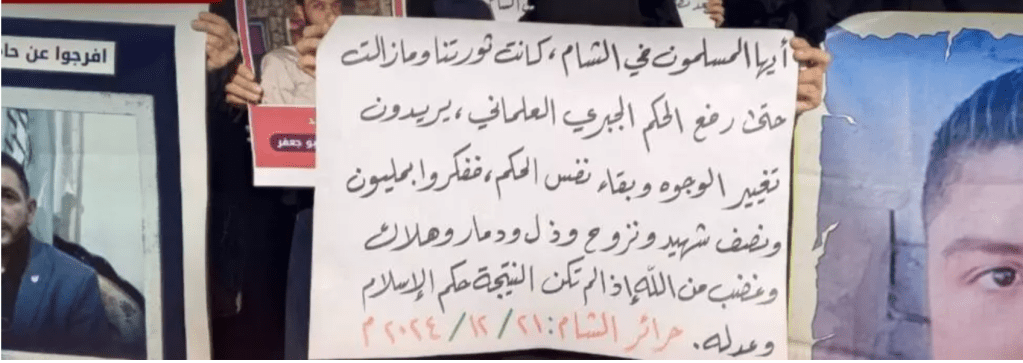
One such leaflet reads: “Our revolution will continue until the secular dictatorship is eliminated. They want to change the faces but keep the same rules.” The statement implies that al-Sharaa has simply become a secular leader, a figure no different from former president Bashar al-Assad.
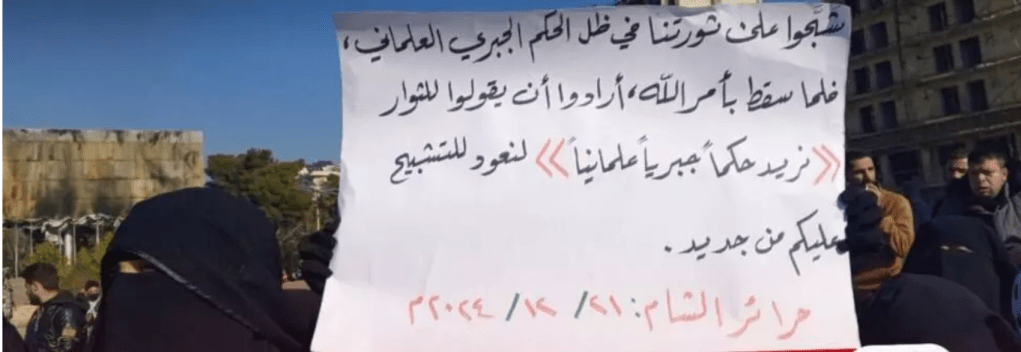
Another leaflet declares: “… When the [secular] regime fell, they told the revolutionaries, they want a secular dictatorship to continue their villainy again.’”
In a widely circulated video, one of the women openly criticises al-Sharaa, accusing him of betrayal: “Our children have been missing for years – the same ones who fought to overthrow the criminal regime and who stood against the injustices committed by al-Jolani in Idlib. Our children are still in Jolani’s prisons to this day.
Jolani has granted amnesty to the Shabiha, the regime’s henchmen who burned, bombed, and killed us for years, but our children remain behind bars. […] We are prisoners of conscience and political prisoners.”
According to video footage, scuffles broke out between the protesters and HTS security forces, whom the families derisively refer to as “al-Jolani’s Shabiha” – a term historically used by Syrians to describe the paramilitary loyalists of the Assad regime. During the clashes, four women were arrested while several others sustained minor injuries
‘Continuing to adhere to Islamist-jihadist ideology was no longer an option’
Thomas Pierret, an expert on jihadist groups in Syria, provides insight into who these families are and why their relatives are being detained by HTS:
Al-Sharaa, the leader of HTS, began purging hardliners from the group’s ranks between 2019 and 2020. He realised that to establish good relations with the outside world, particularly with Western countries, he needed to eliminate extremists, whether they came from his own ranks or from other factions under his command.
To create a viable political and military project in Syria, continuing to adhere to Islamist-jihadist ideology was no longer an option.
This policy of deradicalisation has undoubtedly sparked tensions within HTS and in the territory it controls. To understand Al-Sharaa’s position, it’s essential to consider that Israel is less than 50 kilometres west of Damascus.
The extremist jihadists strongly opposed his more pragmatic approach, which they viewed as overly tolerant. Others were dissatisfied that he confined HTS’s ambitions to Syria, abandoning the global jihadist agenda.
As a result, hardline Salafists faced a choice: either leave HTS-controlled territory or agree to submit to Al-Sharaa’s leadership and fight solely under HTS command, regardless of whether they were Syrian or foreign fighters.
For example, one group of Chechen fighters chose to leave Syria, while another group accepted Al-Sharaa’s conditions and remained as his foot soldiers. Similar decisions were imposed on other jihadist factions.
Between 2020 and 2023, Al-Sharaa went so far as to arrest several radical HTS commanders, often accusing them of espionage. Obedient commanders, however, retained their positions. Many other hardliners were disarmed, placed under house arrest, imprisoned, or subjected to surveillance.
Research conducted by me, based on the names and photos of the detained jihadists displayed on the leaflets carried by the demonstrators, indicates that many of the detainees are members of Hizb ut-Tahrir. This jihadist group, founded in the 1950s by a Palestinian cleric, has been active in Syria since the early days of the country’s civil war in 2011.
Pierret highlights a key distinction between Hizb ut-Tahrir (HT) and Hay’at Tahrir al-Sham (HTS), emphasising that while HT is no more violent in its actions than HTS, it espouses a far more extreme ideology and remains committed to a global jihadist agenda:
‘What lies ahead, remains uncertain’
This protest, for instance, was organised by families of imprisoned jihadists. Many of them are affiliated with Hizb ut-Tahrir (HT) which is a global jihadist group.
Long before the emergence of al-Qaeda and ISIS, Hizb ut-Tahrir was the sole Islamist organisation advocating for a unified Islamic caliphate spanning the Islamic world and regions with historical ties to Islam.
For now, HTS’s dominant military power, territorial control, and image as a liberator have overshadowed groups like Hizb ut-Tahrir. What lies ahead, however, remains uncertain.
In the meantime, the conflict is far from over. The Islamic State (ISIS) [or Islamic State group] continues to operate in Syria and will undoubtedly seize the opportunity to recruit disaffected hardliners in the country. This could lead to renewed violence against Al-Sharaa and HTS.
‘HTS operates more as a military organisation than a religious group’
According to Pierret, Syrian detainees are not the only jihadists held in what some refer to as “al-Sharaa’s prisons”. Many of those imprisoned are foreign jihadists, though their families refrain from openly protesting against the new authorities in Syria, fearing reprisals.
While Ahmed al-Sharaa has traded his turban for a tie, many experts argue that this transformation does not signal a commitment to democracy. Pierret notes:
There is a good chance that Al-Sharaa will follow the same trajectory as some South American dictators before him. Perhaps he will become yesterday’s liberator and today’s dictator. Not exactly an Islamist dictator, as we have seen in Iran, which has evolved into an Islamic theocracy.
Today, HTS operates more as a military organisation than a religious group.
A 2024 report by Reporters Without Borders revealed that at least six journalists were abducted by HTS between 2018 and 2021, underscoring the continued risks faced by those working under the group’s rule.
This article was published first in France24.
 Ershad Alijani