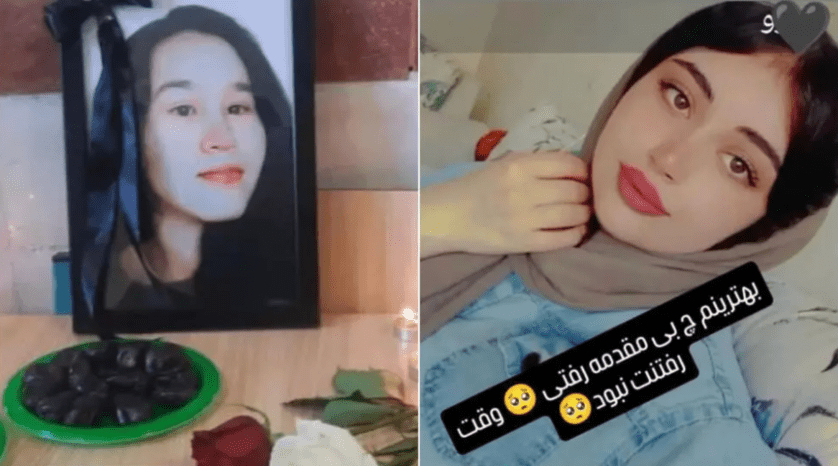
The enforcement of hijab rules in Iran is once again making tragic headlines. Over the past two weeks, two teenage girls took their own lives after reportedly facing intense pressure in their schools. Sixteen-year-old Arezou Khavari jumped from a building, and 17-year-old Ainaz Karimi hanged herself. Both were students at public schools in impoverished regions of the country.
According to Iranian teachers interviewed by me, the country’s education system is structured to exert relentless pressure on students – particularly young girls – to conform to the strict dictates of Islamic Sharia law.
While news of student suicides occasionally surfaces in Iranian media for various reasons, this is the first reported instance of two teenage girls taking their lives specifically due to pressure over the hijab. The incidents have sparked fresh outrage across Iranian society.
On October 27, Ainaz Karimi, 17, took her own life in a village near Kazerun, in southwestern Iran. She had reportedly been insulted, humiliated in front of her classmates, and threatened with expulsion for wearing nail polish and dyeing her hair. As punishment, she was banned from attending classes for the day.
Before leaving school, she reportedly told the principal, “I’m going to kill myself.” That evening, she returned home and hanged herself with her scarf. Sources close to her family say the Ministry of Education has “promised to investigate the incident”.
The second tragedy occurred on November 2. Arezou Khavari, a 16-year-old Afghan immigrant living in a poor suburb southwest of Tehran, was expelled from school for three days after she removed her school uniform, which had become dirty. In Iran, girls’ uniforms typically consist of a black headscarf and a dark blue, oversized manteau.
Her school’s principal also called Arezou’s father, who, according to family sources, threatened her, saying, “I will bury you alive.” That same day, Arezou climbed to the top of a six-storey building on her way home and jumped. She later died in hospital from her injuries.
The Iranian Ministry of Education confirmed Ainaz Karimi’s suicide in a statement on November 3 but claimed the cause was “not yet known” and remained “under investigation”. The ministry has made no public comment about the death of Arezou Khavari.
Harassment, violence, arrests, and fines over hijab violations in public, enforced by Iran’s morality police, are a daily reality for Iranian women. Yet the gap between the theocratic government in Tehran and a society that is increasingly embracing liberal values has only grown wider. As younger generations adopt more liberal “Western” lifestyles, schools have become one of the primary battlegrounds in this cultural conflict, according to local observers.
‘Pressures are not new, the anger in these new generations is’
Anahita [not her real name] is a teacher at a private school in northern Iran. She describes how the Tehran regime has implemented a system designed to control women from an early age, forcing them to conform to a restrictive lifestyle based on Islamic Sharia law.
The problem starts from the beginning. It’s about the teacher recruitment process, which is controlled from A to Z by the Ministry of Education. Candidates aren’t chosen based on merit; they’re selected for their knowledge of Sharia and proof that they practise it in their daily lives. They go through an intensive interview, where they’re asked whether they pray five times a day, whether they fast, how strictly they observe hijab, whether they attend Friday prayers every week, and other mindless details of Sharia. So just to enter the system, candidates must either be hardliners or pretend to be.”
She continues: “If someone wants to advance in this system, it’s not about merit, hard work, better skills, or knowledge. It’s about demonstrating that as a teacher or principal, you rigorously enforce these Sharia rules. You push, pressure, or even report your own students to the authorities if they don’t wear the hijab or show what’s seen as ‘problematic’ attitudes or beliefs.
From time to time, we receive ‘secret instruction letters’ from the ministry, sometimes detailing exactly how we’re supposed to enforce hijab rules, even down to the colours students are allowed to wear. They come and check our CCTV footage to see if our students are wearing hijab. Just this week, they forced our school to fire the most popular teacher because she posted photos of herself on Instagram without a hijab.
‘Schools are responsible for these suicides’
Anahita goes on to highlight the impact of these pressures on students, particularly younger generations.
These pressures aren’t new … What’s new is the anger, the resistance in this younger generation. In our generation, we accepted whatever horror our teachers imposed on us, but these younger generations won’t bend.
If students face this kind of treatment in school and have no one to turn to – no family support – the situation can become volatile. Students may get angry, depressed, or make dramatic decisions, like ending their lives. There’s no doubt that schools bear responsibility for these suicides. It’s simple: on one side are minors, on the other are adults. The adults are responsible.
She emphasises the stark differences between public and private schools.
The situation in public schools is terrible, and in poorer regions, it’s even worse. But in private schools, it’s somewhat better. For one, families are paying, so the schools can’t harass their children as much. And parents can see the environment before enrolling their kids – they can tell if the teachers or principal are hardliners or are ‘okay’.
In other words, if families have money and can send their children to a private school, those children are protected to some extent. If not, in most cases they’re at the mercy of these hand-picked zealots.
There are no reliable statistics on student suicide rates in Iran. However, a rare survey published by the education ministry in 2021 reported that the “risk” index among Iranian students had increased tenfold in the previous six years, with suicide consistently listed as one of the top three risk factors.
This article was published first in France24.
 Ershad Alijani