Latest Posts

Left: An Iranian dancer practises pole-dancing in a private underground venue. Right: Another Iranian woman performs aerial dance in a women-only gym. In a country where women are banned from riding motorbikes, singing or dancing in public and appearing in public without a hijab, both aerial and pole dance are acts of defiance and, for many, forms of resistance.

‘It’s feminist and it’s badass’: the Iranian women taking up pole dancing and aerial dance

Hanging from a rope, a harness or a hoop, Iranian women are flocking to gyms to perform aerial dance and sharing videos of their routines on social media. Others are quietly practising another form of self-expression – pole-dancing – in underground venues hidden from Iran’s security forces. In a theocracy where women are banned from riding motorbikes, singing in public or appearing outside without a hijab, aerial dance and pole dancing are revolutionary acts.

Nearly three years after the death of Mahsa Amini kicked off the “Woman Life Freedom” protests, women’s gyms across Iran are offering a new sport: aerial dancing, or “aerial” for short. The demand is so high that, as one coach puts it, “you can’t find a gym without an aerial class”.

Aerial dance is a form of acrobatic performance that has gained popularity around the world since the 1970s. It involves dancers executing athletic and artistic movements while suspended in the air, hanging from an apparatus such as a rope, a hoop, or a horizontal bar.

In order to avoid repression by Iran’s Islamic regime, promoters of aerial dance in Iran present the activity as a sport, not dance.

For pole dancing, it’s a different story. Pole dancing, in which women do acrobatic manoeuvres on a fixed vertical pole, has its roots in North American strip club culture. While the practice has been reclaimed by American feminists and widely adopted in gyms around the world, its association with eroticism places it firmly in the red zone of acts forbidden by the Islamic Republic. These performances take place in underground, makeshift venues: hidden rooms inside private homes scattered across the country.

Because of the regime’s strict restrictions, no audience is allowed for either practice. Everything unfolds behind closed doors, whether in gyms or secret, private spaces. Yet social media has given these Iranian dancers a stage. By posting clips of their performances, their stumbles, and their growth, they’ve built loyal followings, even as they risk fines, arrest, and the permanent closure of their social media accounts.

Pole dancing’s association with eroticism places it deep in the red zone of forbidden acts in Iran. Performances take place in underground, makeshift venues – hidden rooms inside private homes across the country. FRANCE 24 has blurred this footage to protect the artist’s identity and safety.

Under Iranian law, grounded in Islamic Sharia, women posting pole dancing videos of underground performances can face heavy prison sentences: up to 10 years for “running dens of vice and immorality”, and an additional two-year sentence for posting “obscene content” online. 

While there are no known cases of prison sentences being handed down for pole dancing, women in Iran report having been summoned for police questioning and having their social media pages taken over by Iran’s cyber police. 

“Feminine strength and the sensual aspect are incredibly appealing to many Iranian women”
Amitis [not her real name] is an aerial dancer who now teaches her own students. Her identity has been withheld due to security concerns.

It was three years ago that my fitness trainer introduced me to this ‘new sport’. I tried it once and instantly fell in love. Back then, it wasn’t well known, and it was hard to find a trainer or a gym to practise in. My trainer had learned it abroad.

But now, just three years later, it’s so popular you’d struggle to find a gym without a space for aerial dance. [Editor’s note: In Iran, gyms are segregated; there are separate gyms for men and for women.] That’s how high the demand is. Some girls initially come just to take a few cool photos for Instagram, and end up falling in love with it, too.

Beyond the physical benefits, there’s the feeling of freedom, the constant battle with gravity, and the self-confidence that comes from being able to defy the fall. It’s addictive. And as the cherry on top, it also has an erotic aspect that celebrates female strength and sensuality. All of this makes it incredibly appealing to many Iranian women.

It’s true that it’s considered a luxury – most women who come are from upper social classes because our classes cost more than a regular gym. But we really do have women from all walks of life. One of my students is six years old, and another is 73.

Most of them aren’t religious, but I also have a religious woman who comes in her black chador. She takes it off to dance. She even has a private Instagram account where she shares her videos, but only with her female friends, of course.

According to Amitis, attitudes towards aerial dance have shifted significantly over the past three years – including within her own circle.

My family didn’t really have a problem with it, even as an erotic art, but they used to make fun of me, comparing me to monkeys. Now they understand how physically demanding and athletic it is.

The men around me who once laughed at it are now asking if I can run sessions for men too. The hardest one to deal with was my boyfriend. He wasn’t happy at all and used to complain about the photos I posted — ‘we see your ass!’ or ‘oh baby, too much skin’. He was jealous because I had a lot of male followers on the page.

But honestly, I get more negative comments from women than from men, things like ‘how inappropriate’ what I’m doing is. Still, when I look back, it’s clear how much things have improved. These days, the majority of the comments and messages I get are supportive. People mostly see us now as fighters.

“I’ve censored myself many times”

But alongside the sense of empowerment, Amitis says there is also a constant threat. Being an aerial or pole dancer in Iran comes with serious risks.

The police harassment is constant, simply because we dance. They summon us, pressure us with questions like: ‘Why do you dance?’ ‘Why do you dress like this?’ ‘This is haram.’ And it goes on and on. Many of my colleagues have lost their social media pages, myself included. I had to shut down my last page after being summoned by the police. But I didn’t back down. I opened another one. I try to wear less revealing clothes now, just to reduce the police harassment as much as possible.

And it’s not only the police. Because of my boyfriend, I’ve censored myself many times. There are photos and videos of performances that I loved but never posted. Yes, there are also some sick men who send vulgar messages and that really gets to my boyfriend. But I try to ignore them. I can’t control what goes on in the minds of sick men.


“It is brave, feminist and is badass”

While aerial dance, as Amitis explained, exists in something of a grey zone, pole dancing faces even greater challenges in the Islamic republic. Pania [not her real name], a pole dancer, describes how she entered the world of underground dance.

It was around five years ago that I discovered pole-dancing. I was athletic – I used to practise gymnastics – and I started watching videos online, mostly on YouTube, for months and months. Eventually, I managed to order a pole dance bar through a shop that imported aerial and gym equipment. They brought one in for me.

I started learning by watching videos and reading whatever I could find. There were no trainers, no gyms where I could practise. I had to decipher every single second of every single move, and I fell hundreds of times. But step by step, I learned. I owned it.

I made an Instagram page, just for friends, and began posting videos of myself dancing. My family is very open-minded, they never had a problem with me dancing or sharing videos. Of course, they worry about the security risks, but that’s all.

Little by little, some friends who saw the videos started asking for training sessions. It began with just a few close friends, in an extra room in our house that we turned into a makeshift studio. Then friends of friends started coming, and now I have dozens of girls who come to dance here.

But every new girl must have a reference, a friend, a student I already know. I can’t let strangers in, because of the security risks.

It’s still not a common field. People don’t really see the athletic side of it, like elsewhere in the world. It’s often dismissed as something only ‘bad girls’ do.

Under Iranian law which is grounded in Islamic Sharia, women posting pole-dancing videos of underground performances can face heavy prison sentences: up to 10 years for “running dens of vice and immorality” and an additional two-year sentence for posting “obscene content” online.

“Pole dancing is a ‘hell no’ to the mullahs”

The girls who come to learn pole dancing usually come from a certain part of society, I’d say upper middle class or wealthy backgrounds, with open-minded families, no doubt. They’re looking for a physical activity, but something different. And pole dancing is very specific, its roots are in strip clubs, the outfits are sexy, and the movements are erotic. That’s part of its DNA. We’re aware of it, and for many young women, that’s exactly the appeal: being fit, being sexy.

And it’s cool, too. Imagine being at a party and someone asks, ‘What do you do?’ and you say, ‘Well, I do pole dance.’ I don’t know about other countries, but in my social circle in Iran, it’s considered classy.

Two years ago, I finally started meeting other pole dancers, and the numbers are growing. Most of them are self-taught like me, with strong athletic backgrounds.

Pole dancing is still a very niche practice in Iran, but it’s not like it was five years ago. Now there are online shops that sell equipment, although they’ve been shut down by the police more than once. Recently, customs even refused to release imported pole dance gear. We live with the constant fear: ‘What if I get arrested?’

On top of that, I get insulting messages, people calling me a ‘whore’, or men sending disgusting photos…

This video shows an Iranian woman practising pole dance in a hidden, makeshift venue. Under Iranian law, such performances can carry prison sentences of up to 10 years.

Despite the way pole dancing is often perceived globally, Pania sees it as a source of empowerment for women in Iran.

Most of the messages I get are actually encouraging. People praise our performances, but the main thing they talk about is our bravery.

And I get it, what we’re doing is dangerous. I’m proud of myself, and of all the girls who do pole dance in Iran. We’re not just superficial girls who want to be sexy. Quite the opposite, we’re rebels. Fighters. And I’d say we all carry a strong sense of feminism.

Among ourselves, we always say that what we’re doing is ‘normalising women’s bodies in the public eye’. And to do that in a place like Iran, right under the mullahs’ noses, that’s brave, that’s feminist, and it’s badass.

Being sexy and in shape is seen as a positive thing almost everywhere in the world. But in Iran, it’s more than that, it’s a statement. A form of resistance. The regime wants to control me, to own my body. And we say no.

Being a woman in Iran means saying no, constantly. Not wearing a hijab is a no. Having a boyfriend or a girlfriend is a no. Singing is a no. And pole-dancing? That’s a hell no, to the mullahs, and to plenty of others too.

First published here on France24.
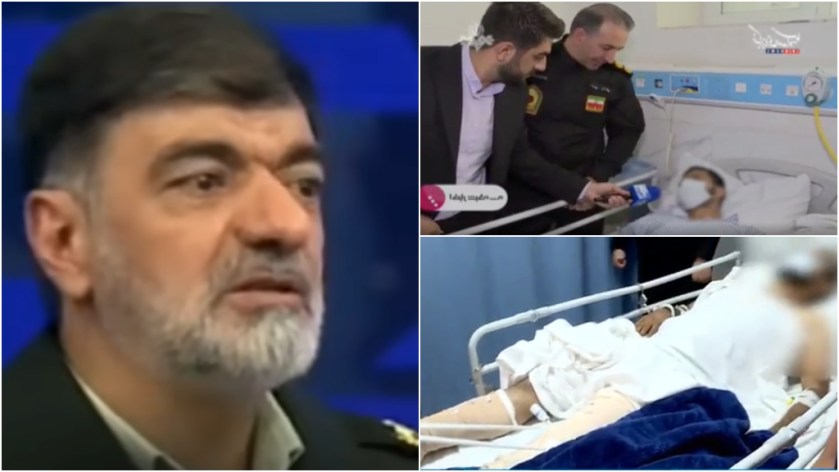
“From now on, we will shoot the thugs,” promised Iran's notorious police chief, Ahmad-Reza Radan. Since then, state media have regularly shown videos of police officers arresting alleged “thugs” who have been shot, usually in one or both legs.

‘We will shoot the thugs’: Iranian police crack down on crime

“From now on, we will shoot the thugs,” promised Iran’s notorious police chief, Ahmad-Reza Radan, in an interview with the media in April 2025. Since then, state media have regularly shown videos of police officers posing with alleged “thugs” they have arrested, saying they have been shot, usually in one or both legs.

The Iranian police are responding to growing criticism of the increase in crime and violence, which some Iranian sociologists believe is due to poverty, trauma and daily stress caused by political unrest and mistrust of institutions.

Images of violent attacks and robberies have become ubiquitous in Iran, with multiple videos recorded by CCTV cameras or mobile phones posted daily on social media.  

Some of the attacks result in the victim’s death, such as an incident on February 12, when two thieves attacked a Tehran University student, stabbing him in the neck while stealing his backpack. The student, Amir Khaleghi, died in hospital.

CCTV footage of the attack triggered several days of protests and strikes at Tehran University. Some days later, Tehran police claimed to have arrested the thieves.

For more than a decade, Iranian society has been grappling with rising criminality, particularly violent offences. While the number of robberies reported per 100,000 inhabitants stood at only 222 in 2006, this figure had surged to 1100 by 2023, according to data from the Statistical Center of Iran.

This graph shows the number of robberies recorded by police in Iran between 2006 and 2023. Source: Statistical Centre of Iran. (The figures for 2007 to 2010 have not been released to the public.) © Observers

Government statistics also show a dramatic rise in the number of violent crimes and attacks, including homicide, violent robberies, and street brawls. Analysts who follow crime and social issues in Iran say the official figures likely understate the worsening crime rate.

‘The police shot me five times’

Facing intense criticism for their inability to tackle violent crime, the Iranian police have responded by resorting to violence themselves. Following police chief Radan’s announcement on April 7, 2025, they have apparently begun shooting alleged criminals in the legs, publishing post-arrest videos of the wounded suspects on social media, and broadcasting them on state television channels. 

The police and the state media routinely refer to the criminals as “thugs”. In one state TV report, the Tehran police commander, Brigadier-General Abasali Mohammadian, is even seen reprimanding one of his officers about an arrested “thug”, asking: “Why is he unharmed?” The officer then apologises.

Mohammadian, the Tehran police chief, declared on May 22: “Crime has fallen by up to 33 percent in recent days because criminals know we shoot at them without hesitation. In the past 48 hours alone, we have shot and arrested five thieves.”


Police response ‘part of the problem, not the solution’

Despite this display of force and swift violence, experts argue that such brutality has no deterrent effect. “Simin” is an Iranian sociologist. (We have concealed her identity because of the sensitivity of talking to foreign media.)

Iran’s legal system has been shaped more by ideology than by practical considerations in defining criminal behaviour. As a result, many perceive the laws as arbitrary or unjust, which fosters defiance. Increasing the severity of punishments is largely ineffective; without addressing the root causes, the cycle of violence continues. What this society needs is fundamental reform: long-term crime prevention and social planning, not mere crackdowns.

The authorities’ short-term response exacerbating violence is part of the problem, not the solution. It is not the first time this approach has been taken. The regime tends to react punitively, favouring criminalisation over preventive social programmes.

‘Injecting further violence only breeds more violence’

“Karoun” (not his real name) is also an Iranian sociologist, he too does not believe in the new method of the Iranian police.

Injecting further violence into society only breeds more violence, both in society at large and in the crimes committed.

Iranians rarely encounter the police on the streets unless it is to arrest women for not wearing the hijab, an action often carried out with violence. Broadly speaking, the police are seen more as agents of political and social control than as enforcers of public safety.

These short-term, sporadic, and arbitrary crackdowns on social phenomena like ‘thuggery’—or crime more generally—are ineffective. Police cannot decide to shoot at people when they want. There are laws that they ignore, and they say it publicly: “We ignore the laws”. They see it as a public relations exercise.

‘If poverty, inequality and government failures are not addressed, the upward trend in violence will continue’

“Simin” says the recent high-profile cases reflect a broad rise in crime in Iran.

Several surveys show that almost half of the Iranian public expect crime and violence to get worse. And the official statistics, even if they are not reliable, do reflect an upward trend in crimes being committed in Iran. There are several reasons for this.

First of all, rising crime in Iran is largely due to chronic poverty, inflation and unemployment fuelling despair. There is a strong link between inequality and violence: Iran’s laws and development plans as well as economic inequalities lead to more poverty and inequality and thus drive up crime, putting people under constant stress, undermining security and provoking aggressive reactions.

At a meeting on crime prevention on May 15, a spokesman for Iran’s judiciary, Asghar Jahangir, said that approximately 80 percent of crimes in Iran stem from inflation and rising prices.

‘Daily stress… heightens public anxiety and fear’

“Simin” continues:

Four decades of revolution, war and conflict have left Iranian society exposed to chronic trauma and instability. Daily stress linked to political unrest—most notably the violent crackdown on the ‘Woman, Life, Freedom’ protests over the past three years, and two instances in which the country stood on the brink of war with Israel—has heightened public anxiety and fear, fuelling a climate of violence.

It is well-established that communities exposed to persistent stress and insecurity—whether through discrimination, crises or disasters—are significantly more prone to aggression. 

Many Iranians feel they are denied employment opportunities simply because they lack connections within the regime, are not affiliated with the Basij, the ideologically driven paramilitary wing of the Revolutionary Guard as an example.

Years of broken promises, repression, and the unequal enforcement of laws have eroded public trust in Iran’s institutions. This trust deficit discourages cooperation with authorities—such as reporting crimes and weakens community cohesion, further fuelling violent crime and social decline.

Reports of assaults, thefts and domestic violence now appear in the news almost daily, reinforcing the perception of a society gripped by a crime epidemic. Both the data and public sentiment point to a nation under immense pressure. Without addressing the root causes – poverty, inequality and governance failures –  the upward trend in violent crime is likely to persist.

Elon Musk’s tweets: Investigating the billionaire’s anti-European rhetoric

The FRANCE 24 Observers -including me- collaborated with France Info and Belgium’s RTBF to analyse the rhetoric of Elon Musk, one of Trump’s closest advisers. This two-part investigation, conducted by the Médias Francophones Publics, examines the X owner’s social media posts, documenting how the billionaire is propagating anti-Ukraine sentiment and posting tweets in support of the European far right.
“I use my tweets to express myself,” Musk said in 2018. Seven years later, and three years after he bought Twitter, Musk uses his own platform, now known as X, to express himself more freely than ever.

With his criticism of Europe and its institutions, attacks on Ukraine and President Volodymyr Zelensky in recent months, Musk has become a vocal supporter of the US presidential camp’s line.

Journalists from Belgium’s RTBF, the FRANCE 24 Observers, and France Info, collaborating under the umbrella of the French-speaking public media association MFP (Médias Francophones Publics), looked at the 15,485 posts published or shared by Musk between November 4, 2024, the day before Trump’s election, and April 4, 2025.

This report was published here first.

Propaganda slip-up: Iran accidentally exposes sensitive missile data

On May 4, 2025, Tehran announced it had tested a new ballistic missile system. Iranian state television swiftly began broadcasting propaganda videos showcasing the test. However, there was a minor oversight: one of the propaganda videos posted on social media inadvertently revealed on-screen data showing the missile’s drag coefficient, a sensitive piece of information that could make it easier for Iran’s enemies to block the missiles.

The new ballistic missile, named “Qasem Basir”, is the latest addition to Tehran’s extensive family of ballistic missiles. It has a range of 1,300km, a lightweight carbon fibre body along with a 500kg warhead, and a camera to ensure precise targeting.

Brigadier General Aziz Nasirzadeh, Iran’s defence minister, who appeared prominently in the propaganda footage, claimed that the new missile system was developed based on experiences gained during two recent Iranian missile attacks against Israel in April and October 2024. “No defence system, neither THAAD nor Patriot, is capable of intercepting Qasem Basir missiles,” Nasirzadeh asserted.

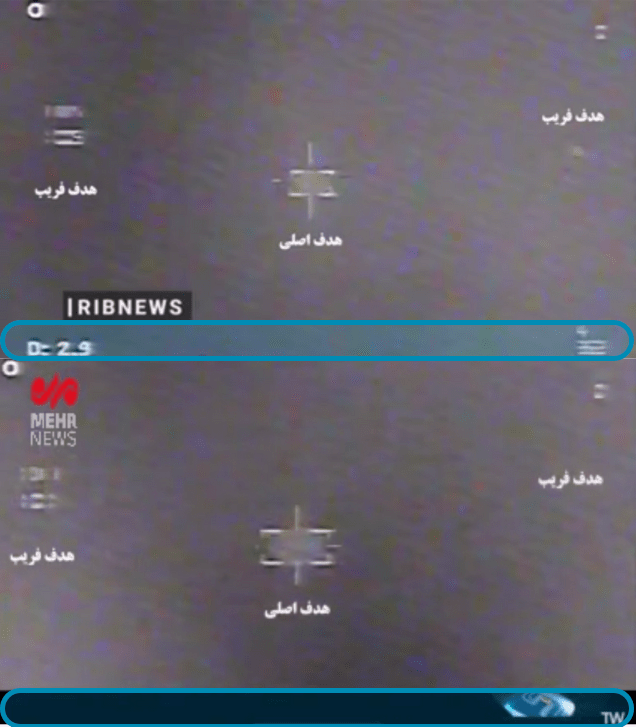
In the version aired on television by state broadcasters, the image from the missile’s camera was obscured with a black band covering a number at the bottom left corner.

In the illustration above, the upper image is a screenshot of a report posted on social networks by Iranian state media on May 4, 2025. The missile’s drag coefficient “D: 2.9” is visible at the bottom left of the image (circled in blue by FRANCE 24). The lower image is a screenshot from the version of the report that aired on television, which includes a black band obscuring the sensitive information. © Observers

However, in an online version of the report posted by state media on social networks the black bar did not appear, revealing a “D” symbol alongside a decreasing number sequence from 3 to 1.2. The D figure refers to the missile’s drag coefficient, indicating air resistance on the missile in the final moments before the impact. 

The inclusion of the sensitive data inadvertently provided Iran’s adversaries with insights into the missile’s behaviour during its final moments, enabling a clearer estimation of its potential speed.

It’s not a catastrophe, but it can help to ‘fine tune’ the defensive systems


Farzin Nadimi is a military expert from the Washington Institute for Near East Policy. He explains the significance of the numbers:

The “D” refers to “drag,” or “fluid resistance”, a physics term describing the force opposite to an object’s motion within a surrounding fluid – in this case, air. When the number decreases from 3 to 1.4, it doesn’t indicate the missile is accelerating; rather, it means the rate at which the missile’s speed decreases is slowing down.

Simply put, [the sudden decline in drag] suggests the missile is doing something to evade defence systems: either adjusting its warhead adjusts to an optimal angle to reduce air resistance, or engaging its final-stage engines. In either scenario, the missile’s manoeuvrability is enhanced, reducing the available reaction time for defence systems.

Now that adversaries have access to this data, it’s not disastrous, but it does provide them with valuable insights into the missile’s aerodynamic characteristics, helping them better calibrate their defence measures.

Overall, Nadimi described the missile as an important advancement for Iran’s missile programme.

They implied lessons learned from previous attacks on Israel. Those attacks revealed that Iranian missiles lacked accuracy at ranges exceeding 2,000 km. To address this issue, Iran incorporated a camera system to adjust missile trajectories for increased accuracy, alongside employing a carbon fibre body, another significant enhancement.

Published here first on France24.

How Elon Musk boosts Europe’s far right on X

To mark the 100th day of US President Donald Trump’s second term, the FRANCE 24 Observers collaborated with France Info and Belgium’s RTBF to analyse the rhetoric of Elon Musk, one of Trump’s closest advisers. This two-part investigation, conducted by the Médias Francophones Publics, examines the X owner’s social media posts, documenting how the billionaire is propagating anti-Ukraine sentiment and posting tweets in support of the European far right. I was lucky to be part of the team.

If you are interested, you can find our investigation here:

Elon Musk’s tweets (1/2): A conduit for pro-Russian anti-Ukraine rhetoric

Elon Musk’s tweets (2/2): Raising the profile of Europe’s far right

Iranian female singers face arrests and police summons

In Iran, at least seven women have recently been arrested or summoned for questioning by police. The Iranian regime does not allow women to sing in public. However, more and more Iranian women are defying the ban, particularly since the “Woman Life Freedom” movement began. In recent weeks, they have been the target of a crackdown.

This report aired and was published first here at France 24.

Vanishing reservoirs, empty taps: how Iran’s water crisis became a national emergency

In recent days, images of vast, dried-up reservoirs near Tehran have circulated on social media. These dams supply water to more than nine million people in the Iranian capital, and their depletion has sparked widespread concern. A combination of decades of drought, mismanagement, and crumbling infrastructure is driving Iran towards an unprecedented water crisis as the Middle East enters its warm season, experts warn.

A video of the Amir Kabir Dam, 30 km northwest of Tehran, taken in August 2024 shows clear blue water reaching up into the hills. In a video from the same vantage point in March 2025, the water has disappeared, replaced by a cracked, desolate lake bed.

A video being widely shared on social media in Iran in March 2025 shows images of the Amir Kabir Dam, also known as the Karaj Dam, taken in August 2024 and then in February 2025. The original poster of the video on Instagram wrote in a caption: “I’m horrified. Can someone explain to me what’s going on?”

Another video being widely shared by Iranians shows a group of motorcyclists driving on the muddy bed of the Latyan Dam reservoir, 15 km northeast of the capital. “You’d be shocked if you knew this was the bed of the Latyan reservoir,” the caption reads.

A video posted on X on March 11, 2025 shows a motorcyclist riding on the muddy bed of what used to be one of the most important water reservoirs for Tehran. The caption says: “You’d be shocked if you knew this is the bed of the Latyan reservoir.”
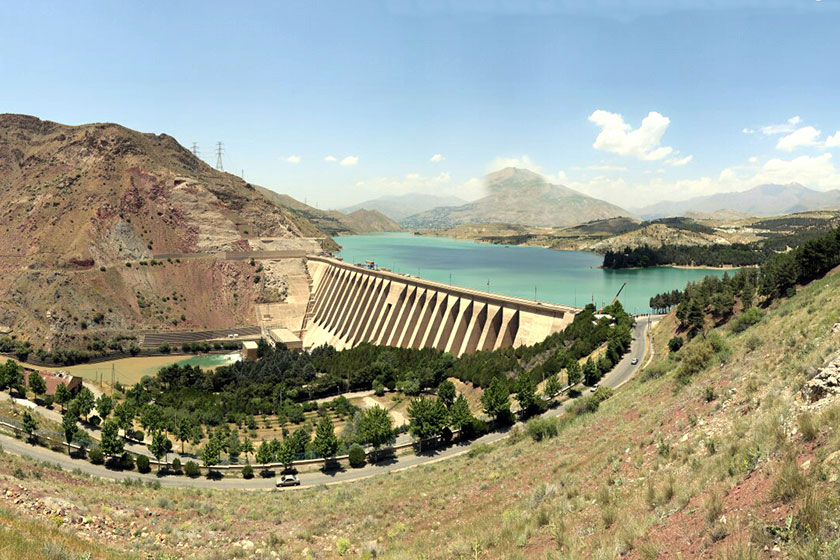
This photograph published in 2023 shows the Latyan Dam northeast of Tehran and the reservoir behind it filled with water. © Shafaghna

Tehran is on the brink of running out of water. Authorities are preparing to introduce rationing, with daily supply cuts expected to curb consumption as shortages worsen, officials and experts say.

Seventy percent of Tehran’s water comes from five nearby dams, including Karaj and Latyan. But an unprecedented dry spell – the rainfall in Tehran since the beginning of 2025 has been the lowest recorded in 55 years – means water levels have been declining fast. State media reported on March 5 that the five reservoirs are only 13% full.

Iran has been suffering from drought for more than 40 years. Water shortages in rural areas have led to tensions between farmers and authorities they accuse of mismanaging water supplies. 

‘It’s an apocalyptic situation’

Shervin [not her real name], an ecology expert in Iran, describes the worsening crisis.

If I want to describe the situation in one word, it’s ‘crisis.’ Right now, as I speak to you, we have a water outage in our house. We called the water company and they told us: ‘There’s a pressure drop in our system, so there’s a water outage in your neighbourhood.’

There’s no doubt that the authorities will have to ration water in the coming days. We’re going to have to get used to going without water for hours each day. Even the water company officials say so. But it’s like with all these kinds of things: nobody pays attention until disaster actually strikes.

In Iran, annual rainfall has decreased by 46% compared with the country’s long-term average. If you combine the capacity of the five main dams that supply Tehran, industry sources say they are only 6% full – despite the official number, 13%. Nine million people in Tehran alone, and 14 million in Tehran province, will soon have no water to drink or to meet basic hygiene needs. If we don’t have rain in the coming weeks – a lot of rain – this will take on apocalyptic proportions.

While Shervin hopes for a rainy spring, the forecasts offer little reassurance. Ahad Vazifeh, head of Iran’s Drought Crisis Management Organisation, told state media on March 9: “We don’t expect a rainy spring this year.” In another interview on March 11 he confirmed: “We will likely ration the water, and if we do not manage the situation, we will face a deep crisis in the warm season.”

The Amir Kabir Dam on the Karaj river, the main source of water for 9 million citizens of the Iranian capital Tehran, has almost dried up. Photo published by Iranian internet users in March 2025.

An unprecedented water shortage

Shervin explains what officials mean by “managing the situation”.

The solution the state is pursuing so far is even worse than having no water. The Ministry of Energy, which oversees the country’s water management, has already applied to drill 250 deep wells in the Tehran region to extract groundwater. But the water beneath Tehran is nothing more than millions of litres of contaminated wastewater, laced with pollutants such as heavy metals – and, like any untreated wastewater, carcinogenic nitrates. This scenario would be a public health disaster.

Another solution they are considering is cutting water supplies to industry and agriculture, which will bring its own economic and social consequences.

While the alarm was first raised by images shared on social media, satellite data and public records indicate that Iran is heading for a much deeper crisis in the coming months – an unprecedented water shortage not just in the capital, but nationwide.

According to official statistics, 57% of Iran’s reservoirs are empty, with some provinces seeing levels as high as 98%.

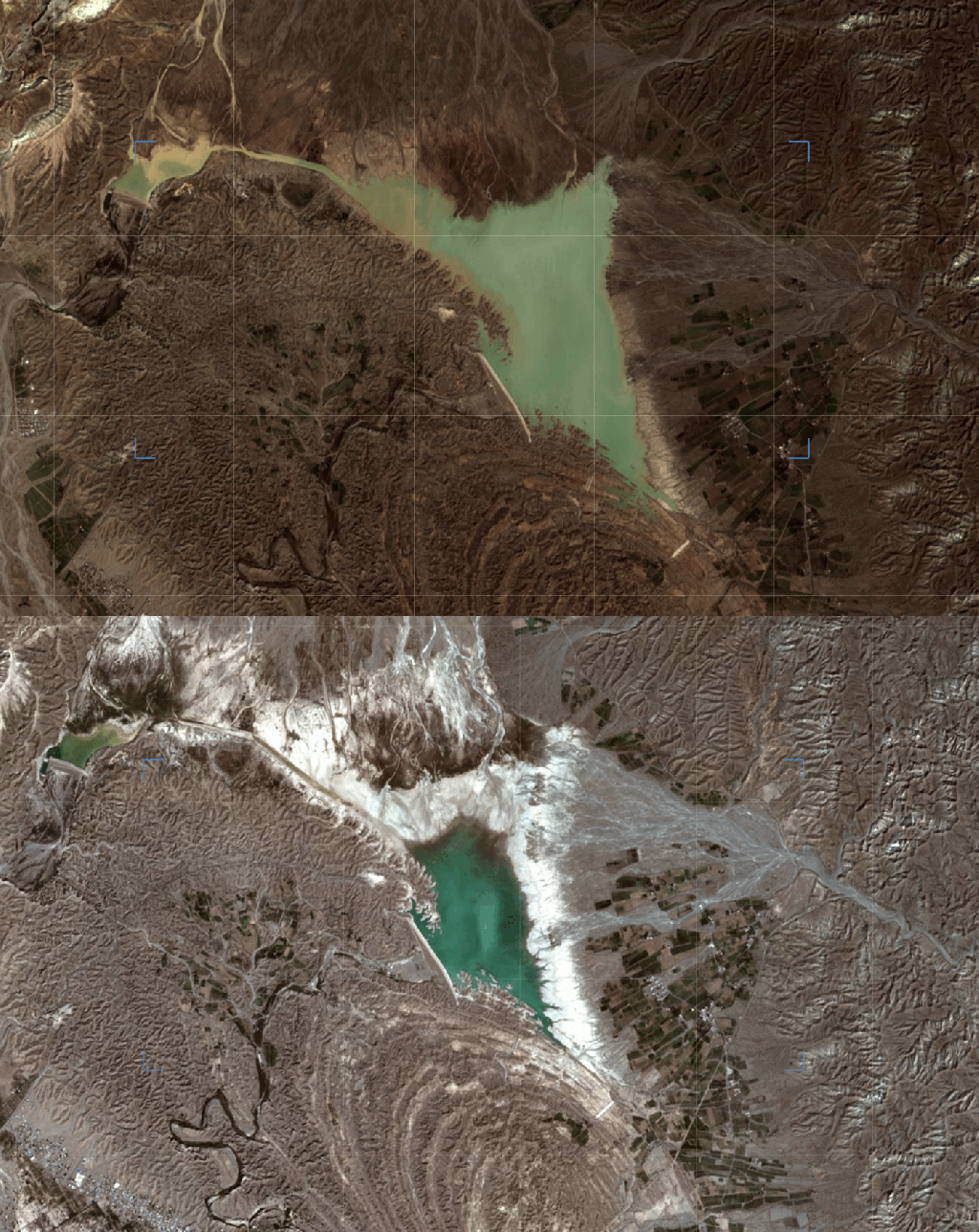
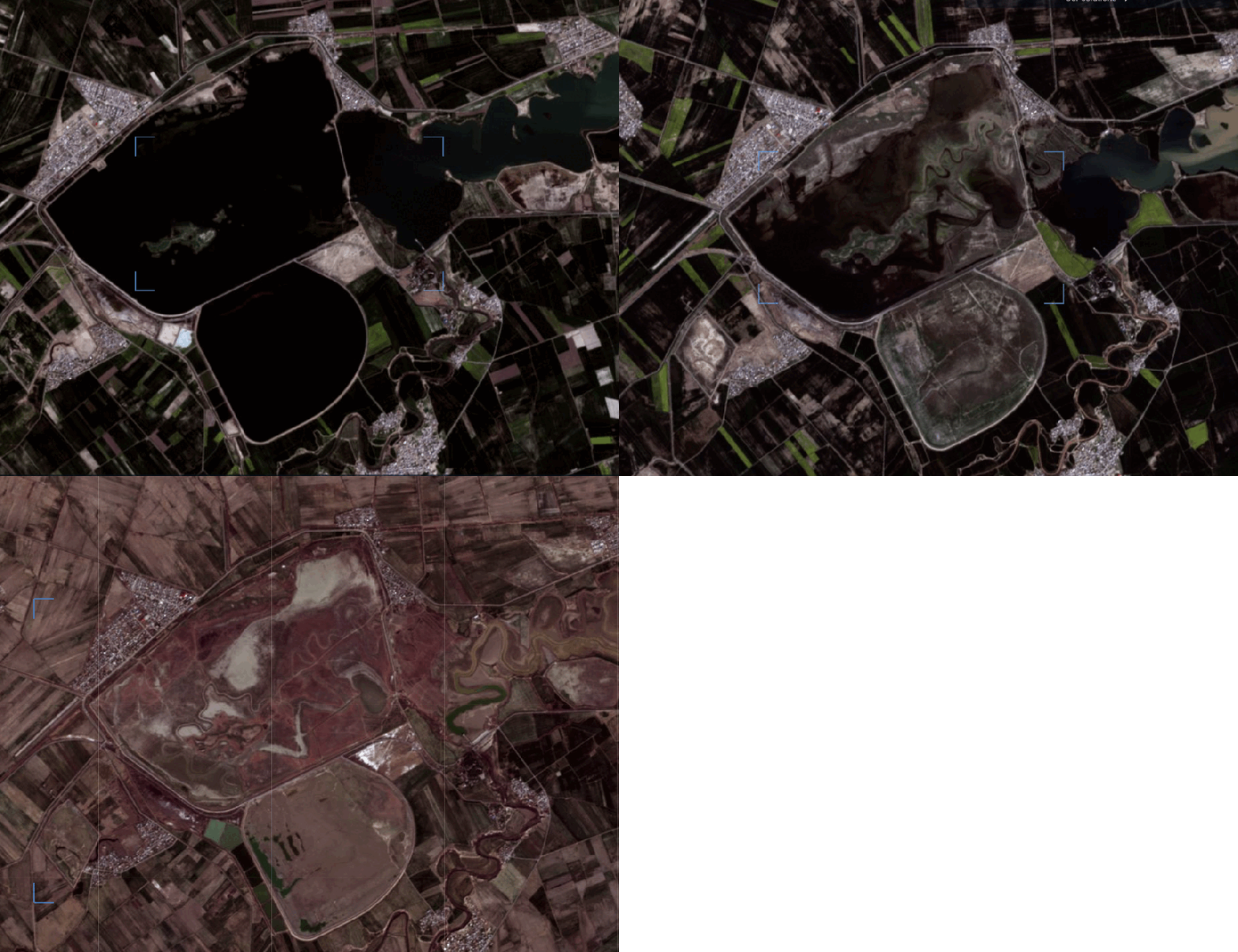
These satellite images show declining water levels at the Shamil Dam in the province of Sistan and Baluchistan in southeastern Iran. The first image was taken on February 27, 2024; the second on March 5, 2025. The water coverage in the reservoir shrank drastically during the 12-month period. Photos by: EOS
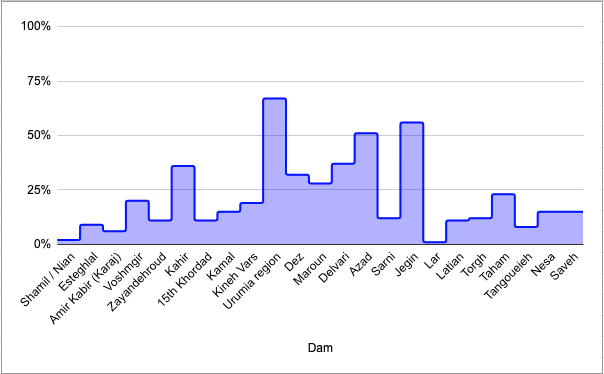
This graph shows the water level at Iran’s major dams in early March 2025 as a percentage of their reservoirs’ capacity. Data released by Iranian official sources indicates that all but three of the nation’s dams are below 40% capacity. In some provinces, they are nearly empty: the Shamil and Nian Dam in Sistan and Baluchistan province (2% of capacity); Esteghlal Dam in Hormozgan province (9% capacity); and Lar Dam in the Tehran region (1% capacity). Source: Ministry of Energy of the Islamic Republic of Iran. © Observers
Voshmgir Dam in Iran’s northwestern Gulestan province. The first satellite image was taken in March 16, 2019. The second image shows the dam’s reservoirs in March 29, 2024. The third image was taken on March 5, 2025. While the lake behind the dam was full in 2019, it had lost a lot of water in 2024 and is almost completely dry in 2025. According to official statistics, it is at 20% capacity with only 22 million litres of water left, 50% less than in 2024. Photos by : EOS

Shervin explains:

It’s a fact that Iran is experiencing a prolonged drought. In a normal year, the country receives just one-third of the global average rainfall, and this year we have had less than 45% of that. Meanwhile, consumption continues to rise due to population growth and changing usage patterns.

This graph compares water levels of reservoirs at Iran’s major dams in March 2025 with their level at the same period in 2024. All but one have lost water since 2024, many of them dramatically. Reservoirs in some cases in Hormozgan Province have lost 91 to 98% of the water they had in 2024. Source: Ministry of Energy of the Islamic Republic of Iran. © Observers

‘Millions of Iranians will be without water – unless there’s a miracle’

Shervin continues:

We have to factor in the broken infrastructure as well. Officially, Iran’s aging pipeline networks waste 15% of the country’s water supply, but the real figure is likely much higher.

Even in 2025, industries here still use potable water in their machinery, and outdated irrigation systems in agriculture waste enormous amounts. Meanwhile, the government continues to promote water-intensive farming in the name of ‘independence’ – a reckless policy for a country facing such an extreme water crisis.

We also lack a proper wastewater treatment system, something that is absolutely essential for a country in Iran’s position.

So with a combination of severe drought and chronic mismanagement, we are in a situation that I have no words to describe. Millions of Iranians will soon have no water for even their most basic needs – unless a miracle happens.

First published here on France24.


“It will be our execution order”: US deportations leave asylum seekers in limbo

An Iranian woman who was among 299 migrants deported by the United States to Panama has appealed to President Donald Trump for a reprieve so she can avoid being sent back to Iran. As a Christian convert, Artemis Ghasemzadeh, 27, could face execution or life in prison under Iran’s Sharia law if she is forced to return.

UPDATE: On Thursday night, all the asylum seekers, including Artemis, were transferred to a camp in the jungle of Darién, near the Panama-Colombia border. Since then, we have lost contact with her.

Speaking to me from the hotel in Panama City where the migrants are being held, Artemis Ghasemzadeh said: “Our first request is a reprieve from President Trump – just for our cases to be reviewed.”

Ghasemzadeh said US officials had confiscated many of the deportees’ phones and that she was the only one talking to the media: “Everyone, really everyone, has asked me to say please do not deport us to our country of origin.”

The Iranians were among the first group of 119 people flown to Panama on a US Army flight on February 12. A second flight followed a day later. A total of 360 people are expected to be removed from the US and sent to Panama.

Speaking at a press conference on February 13, Panamanian President José Raúl Mulino commented on the arrivals coming from “places like China, Uzbekistan, PakistanAfghanistan, and all of the ‘Stans.’ (…) They are temporarily staying in a local hotel and from there will be transported to a shelter we have in San Vicente, in Darién. We hope to get them out of there as soon as possible through flights.”

Panama’s Security Minister Frank Abrego said Tuesday that 171 of the 299 deportees have agreed to return voluntarily to their respective countries with help from the International Organization for Migration and the UN Refugee Agency.

Iranian woman’s video appeal goes viral online

Ghasemzadeh first gained attention by posting a dramatic call for help from the Decapolis Hotel in Panama City, where the deportees are being held. She described how the deportees were handcuffed and shackled by masked American soldiers before being placed on a military aircraft without being informed of their destination. After a seven-hour flight, they realised they had arrived in Panama when they saw the badges of the Panama police. “We are twelve Iranians who have all converted to Christianity, and there is no way they could deport us to Iran,” she says in the video.

 ‘I wonder why Afghan women and Iranians whose lives are at risk were on the first deportation flight’

I contacted Ghasemzadeh at the hotel on Tuesday. Here is her account:

The accommodation here is good, but we are not allowed to leave the hotel. We cannot even go to other floors. We are on the eighth floor and can only eat in the restaurant on the first floor before going straight back to our rooms. Panamanian police officers accompany us everywhere.

The only time we can see and talk to other asylum seekers is when we are taken to the restaurant to eat. 

I am the only person with a connection to the outside world, so during mealtimes, we exchange news and try to keep each other informed.

Armed soldiers monitor every movement of the asylum seekers, restricting their access to other floors and preventing them from using the elevators alone. © Observers

I had attempted to contact the Decapolis Hotel as early as February 14, but staff initially denied that refugees were staying there. They later refused to respond to further inquiries from journalists. Panama’s government has since barred reporters from visiting the hotel or speaking with the detainees.

Artemis continues:

While the first flight was mainly families, the Americans separated relatives on the second flight. The men are apparently still in the US, while the women have been deported. We had Afghan and Iranian friends in the detention camp who had husbands, brothers, or other male relatives, but they were separated. On the second flight, the women were deported first –Afghans, Iranians, and others.

We are really worried. We have no idea what will happen to us here. The president of Panama has said they plan to move us to a camp in a forested area of the Darién region. I have heard from others who have been there that the health and hygiene conditions are terrible. And from there, they want to deport us to our countries of origin.

We were able to find a lawyer here in Panama, but the police will not let us meet them. I don’t think that’s legal.

We have documents proving that we face imminent danger if returned – some of us risk execution or life imprisonment in Iran, as our lawyers have confirmed.

‘We are willing to go to any other country where we can live safely’

While Ghasemzadeh has expressed fear over what would happen if they were deported to Iran or Afghanistan, Tricia McLaughlin, a spokeswoman for the US Department of Homeland Security, disputed such concerns. “Not a single one of these aliens asserted fear of returning to their home country at any point during processing or custody,” she claimed.

Artemis said:

There are also Afghan girls here who have been separated from their siblings. They are terrified of what will happen if they are deported into the hands of the Taliban. They say that if they send us back, it will be our execution order, already signed.

I applied for asylum in the US, but I never saw a court or a judge, nor did I receive any formal deportation notice.

Before I crossed the border from Mexico about a month ago, I had heard President-elect Trump say he would tighten deportation measures. But we thought he meant criminals, not people who are genuinely in danger and have done nothing wrong.

Everyone, really everyone, has asked me to say please do not deport us to our country of origin, we are in danger there.

Our first request is a reprieve from President Trump – just for our cases to be reviewed.

 But if the US doesn’t want us, that doesn’t matter. We are willing to go to any other country where we can live safely, even here in Panama. If there is a country that truly upholds human rights, we ask them to consider our cases.

Some churches in the US have reached out to support us, but so far, nothing has changed. We are stuck in a deep state of uncertainty.

According to The New York Times, conditions in the hotel have become increasingly desperate. At least one person has attempted suicide, while another broke his leg trying to escape. Since then, authorities have confiscated all sharp objects from detainees’ rooms.

Panama is not the only country to have accepted deported migrants from the US. Under pressure from Washington, Guatemala and El Salvador have also agreed to receive asylum seekers from other nations.

In response to Artemis’s viral video, a spokesperson from the Iranian foreign ministry declared on February 15: “Iran is for all Iranians and they can come back.” Artemis, however, does not believe this: “Anyone who has even an ounce of knowledge about the Islamic Republic knows that this is a lie,” she told me.

First published here on the France24 website.

Macron-Modi Meeting: Debunking Viral Misleading Claims

After the international AI summit in Paris, media outlets and social media accounts linked to the Russian government circulated a video claiming that French President Emmanuel Macron had snubbed Indian Prime Minister Narendra Modi, ignoring him and refusing to shake his hand. However, this claim is misleading. A longer version of the same footage shows that the two leaders had already met outside the venue and entered together. Additional photos and videos confirm that they had shaken hands beforehand.

The claim first surfaced on 11 February on Sputnik, Russia’s state news agency, which is widely regarded as a mouthpiece for Russian government propaganda. The outlet Russian-langage service reported: “Macron defiantly ignored Indian PM Modi and did not shake his hand at the AI summit in Paris.”
The allegation was accompanied by a video appearing to show Macron disregarding Modi’s extended hand. The French president was then seen greeting other world leaders at the closing ceremony of the Artificial Intelligence Action Summit in Paris on February 11, including US Vice President JD Vance and European Commission President Ursula von der Leyen.

The false claim was amplified by various pro-Russian media outlets, then picked up by international media and social media users in multiple languages, including English, French, Persian, and Arabic. The video quickly went viral in India, sparking widespread shock and anger among many users.

Indians on social media picked up a false report by Russia’s Sputnik news agency saying that French President Emmanuel Macron had snubbed Indian Prime Minister Narendra Modi at a summit in Paris. © Observers

However, a longer version of the same video, capturing the moments before the apparent snub, shows that Modi and Macron entered the venue side by side, having already met outside as planned.

Video posted on X shows French President Emmanuel Macron entering an AI summit in Paris on February 11, 2025 alongside Indian Prime Minister Narendra Modi. It shows that the two men had already greeted each other when Macron shook hands with other world leaders minutes later.

Photos published by multiple news agencies documented that the handshake between the two heads of state took place a few seconds before they entered the meeting.

According to the Associated Press and Reuters, Modi and Macron met at the entrance to the summit venue at 10:11am Paris time.

They entered side-by-side a few minutes later, as recorded by cameras inside, and then Macron began his closing speech.

According to the timestamp of this Reuters photo, the two leaders met and shook hands at 10:11am Paris time on February 11, 2025.

According to the timestamp of this Reuters photo, the two leaders met and shook hands at 10:11am Paris time on February 11, 2025. © AP

Then both heads of state joined other world leaders at the summit. The timestamp on this Reuters photo documents the moment when they entered the meeting at around 10:20am Paris time.

The timestamp on this Reuters photo documents the moment when they entered the meeting at around 10:20am Paris time. © Reuters

Then French President Macron gave a speech at the closing ceremony, as the timestamp on this AP photo shows.

Then French President Macron gave a speech at the closing ceremony, as the timestamp on this AP photo shows. © AP

The clip circulated by the Russian agency is thus misleading. In the footage, Macron extends his hand to greet someone standing behind Modi, while the Indian leader momentarily mistakes the gesture as intended for him.

First published here on the France24 website.