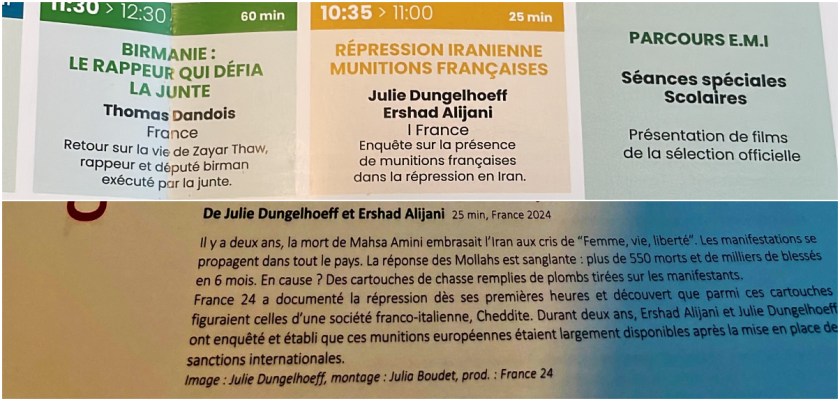
I am thrilled to announce that “Repression in Iran, Ammunition Made in France“, the investigation I conducted with my esteemed colleague Julie Dungelhoef, has been selected for the 32nd FIGRA Festival in the documentary competition (under 40 minutes).
This two-year investigation uncovered how French-made shotgun shells ended up in Iran and were used against Woman, Life, Freedom protesters—despite international sanctions.
Shedding light on this injustice would not have been possible without the courage of Iranians who sent us hundreds of photos and the bravery of Elaheh and Sima, two victims of shotgun fire, who shared their harrowing experiences.
On December 14, dozens of protesters—mostly women and children—gathered in Aleppo in northern Syria to demand the release of their relatives from the prisons of Hay’at Tahrir al-Sham (HTS). Yet the detainees are not pro-democracy activists or journalists imprisoned by the Islamist group: they are hardline jihadist fighters who rejected HTS’s increasingly pragmatic approach since the group began distancing itself from al-Qaeda and the Islamic State (IS) group.
This shift began after the group’s founding in 2017 under Ahmed al-Sharaa, better known by his nom de guerre Abu Mohammed al-Jolani. The detainees call themselves “The Real Mujahideen.”
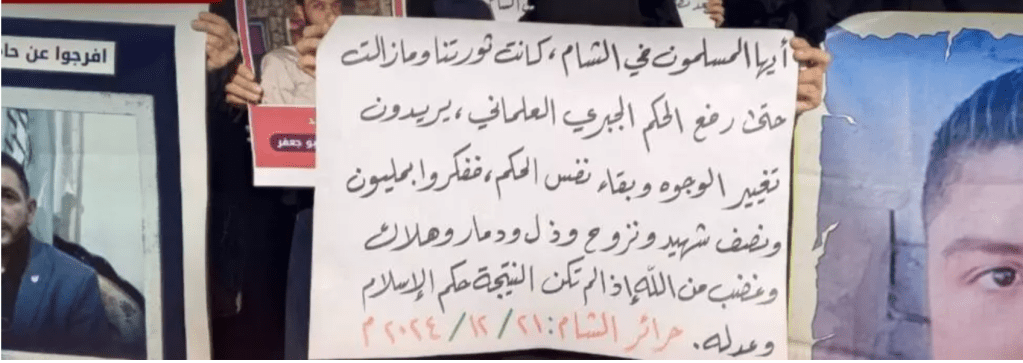
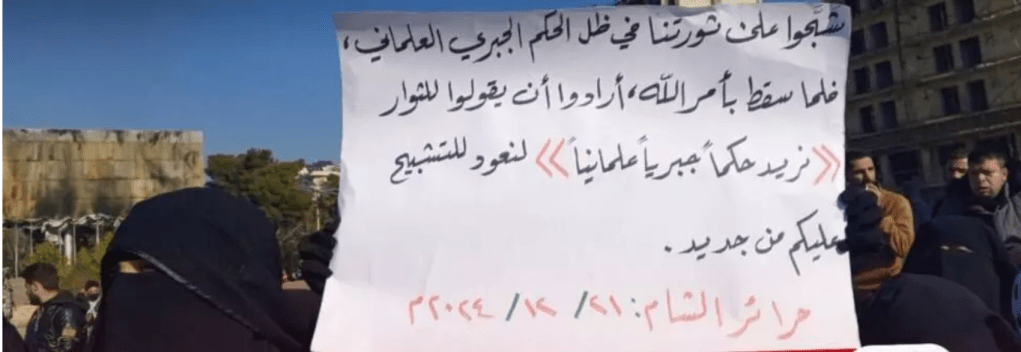
Among the demonstrators were women dressed in black burqas with leaflets in hand, chanting slogans and demanding the release of their relatives while carrying their photos. They refer to themselves as the “Free Women of the Levant.” The protest marks the first anti-HTS demonstration since the group seized control of Damascus and toppled the Bashar al-Assad regime.
These women make no effort to hide their disdain for Ahmed al-Sharaa, the new leader of Syria and HTS, expressing their grievances in the leaflets they distribute.
One such leaflet reads: “Our revolution will continue until the secular dictatorship is eliminated. They want to change the faces but keep the same rules.” The statement implies that al-Sharaa has simply become a secular leader, a figure no different from former president Bashar al-Assad.
Photo published on the jihadist groups on Telegram on Dec 14: “… When the [secular] regime fell, they told the revolutionaries, they want a secular dictatorship to continue their villainy again.’”
Another leaflet declares: “… When the [secular] regime fell, they told the revolutionaries, they want a secular dictatorship to continue their villainy again.’” In a widely circulated video, one of the women openly criticises al-Sharaa, accusing him of betrayal: “Our children have been missing for years – the same ones who fought to overthrow the criminal regime and who stood against the injustices committed by al-Jolani in Idlib. Our children are still in Jolani’s prisons to this day.
Jolani has granted amnesty to the Shabiha, the regime’s henchmen who burned, bombed, and killed us for years, but our children remain behind bars. […] We are prisoners of conscience and political prisoners.”
According to video footage, scuffles broke out between the protesters and HTS security forces, whom the families derisively refer to as “al-Jolani’s Shabiha” – a term historically used by Syrians to describe the paramilitary loyalists of the Assad regime. During the clashes, four women were arrested while several others sustained minor injuries
‘Continuing to adhere to Islamist-jihadist ideology was no longer an option’
Thomas Pierret, an expert on jihadist groups in Syria, provides insight into who these families are and why their relatives are being detained by HTS:
Al-Sharaa, the leader of HTS, began purging hardliners from the group’s ranks between 2019 and 2020. He realised that to establish good relations with the outside world, particularly with Western countries, he needed to eliminate extremists, whether they came from his own ranks or from other factions under his command.
To create a viable political and military project in Syria, continuing to adhere to Islamist-jihadist ideology was no longer an option.
This policy of deradicalisation has undoubtedly sparked tensions within HTS and in the territory it controls. To understand Al-Sharaa’s position, it’s essential to consider that Israel is less than 50 kilometres west of Damascus.
The extremist jihadists strongly opposed his more pragmatic approach, which they viewed as overly tolerant. Others were dissatisfied that he confined HTS’s ambitions to Syria, abandoning the global jihadist agenda.
As a result, hardline Salafists faced a choice: either leave HTS-controlled territory or agree to submit to Al-Sharaa’s leadership and fight solely under HTS command, regardless of whether they were Syrian or foreign fighters.
For example, one group of Chechen fighters chose to leave Syria, while another group accepted Al-Sharaa’s conditions and remained as his foot soldiers. Similar decisions were imposed on other jihadist factions.
Between 2020 and 2023, Al-Sharaa went so far as to arrest several radical HTS commanders, often accusing them of espionage. Obedient commanders, however, retained their positions. Many other hardliners were disarmed, placed under house arrest, imprisoned, or subjected to surveillance.
Research conducted by me, based on the names and photos of the detained jihadists displayed on the leaflets carried by the demonstrators, indicates that many of the detainees are members of Hizb ut-Tahrir. This jihadist group, founded in the 1950s by a Palestinian cleric, has been active in Syria since the early days of the country’s civil war in 2011.
Pierret highlights a key distinction between Hizb ut-Tahrir (HT) and Hay’at Tahrir al-Sham (HTS), emphasising that while HT is no more violent in its actions than HTS, it espouses a far more extreme ideology and remains committed to a global jihadist agenda:
‘What lies ahead, remains uncertain’
This protest, for instance, was organised by families of imprisoned jihadists. Many of them are affiliated with Hizb ut-Tahrir (HT) which is a global jihadist group.
Long before the emergence of al-Qaeda and ISIS, Hizb ut-Tahrir was the sole Islamist organisation advocating for a unified Islamic caliphate spanning the Islamic world and regions with historical ties to Islam.
For now, HTS’s dominant military power, territorial control, and image as a liberator have overshadowed groups like Hizb ut-Tahrir. What lies ahead, however, remains uncertain.
In the meantime, the conflict is far from over. The Islamic State (ISIS) [or Islamic State group] continues to operate in Syria and will undoubtedly seize the opportunity to recruit disaffected hardliners in the country. This could lead to renewed violence against Al-Sharaa and HTS.
‘HTS operates more as a military organisation than a religious group’
According to Pierret, Syrian detainees are not the only jihadists held in what some refer to as “al-Sharaa’s prisons”. Many of those imprisoned are foreign jihadists, though their families refrain from openly protesting against the new authorities in Syria, fearing reprisals.
While Ahmed al-Sharaa has traded his turban for a tie, many experts argue that this transformation does not signal a commitment to democracy. Pierret notes:
There is a good chance that Al-Sharaa will follow the same trajectory as some South American dictators before him. Perhaps he will become yesterday’s liberator and today’s dictator. Not exactly an Islamist dictator, as we have seen in Iran, which has evolved into an Islamic theocracy.
Today, HTS operates more as a military organisation than a religious group.
A 2024 report by Reporters Without Borders revealed that at least six journalists were abducted by HTS between 2018 and 2021, underscoring the continued risks faced by those working under the group’s rule.
A two-year investigation by FRANCE 24 has revealed that hunting cartridges produced by the French-Italian ammunition manufacturer Cheddite were used in Iran during the violent crackdown on the “Woman, Life, Freedom” protests in 2022. The investigation uncovers how these cartridges are widely available in Iran, despite European sanctions imposed in 2011. It appears the ammunition may have been routed through Turkey, where Cheddite at one point held shares in a weapons manufacturing company. This investigation, broadcast by FRANCE 24, sheds light on the dealings that allowed the ammunition to reach Iranian soil, despite international sanctions.
This investigation was produced by Ershad Alijani and Jullie Dungeloef. You can watch it on YouTube above and read the full story here on France24.
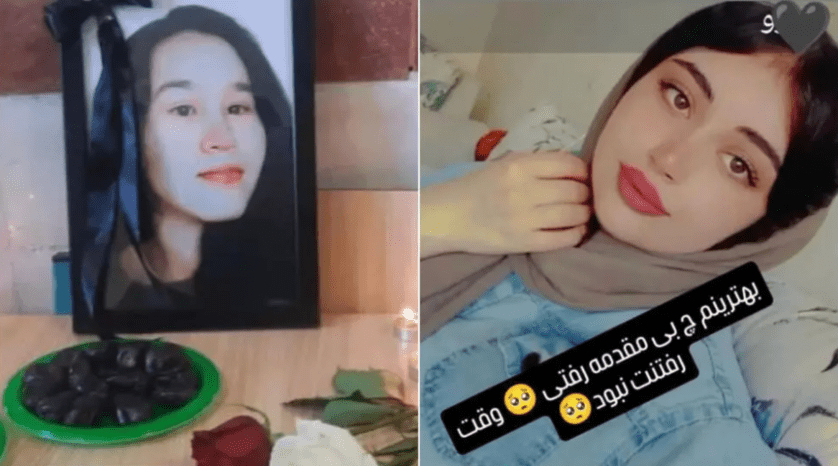
The enforcement of hijab rules in Iran is once again making tragic headlines. Over the past two weeks, two teenage girls took their own lives after reportedly facing intense pressure in their schools. Sixteen-year-old Arezou Khavari jumped from a building, and 17-year-old Ainaz Karimi hanged herself. Both were students at public schools in impoverished regions of the country.
According to Iranian teachers interviewed by me, the country’s education system is structured to exert relentless pressure on students – particularly young girls – to conform to the strict dictates of Islamic Sharia law.
While news of student suicides occasionally surfaces in Iranian media for various reasons, this is the first reported instance of two teenage girls taking their lives specifically due to pressure over the hijab. The incidents have sparked fresh outrage across Iranian society.
“The compulsory hijab is still claiming lives in Iran, a few days after Ainaz Karimi now Ainaz Khavari…”
On October 27, Ainaz Karimi, 17, took her own life in a village near Kazerun, in southwestern Iran. She had reportedly been insulted, humiliated in front of her classmates, and threatened with expulsion for wearing nail polish and dyeing her hair. As punishment, she was banned from attending classes for the day.
“Funeral of Ainaz Karimi in her village in southwest Iran on November 8”
Before leaving school, she reportedly told the principal, “I’m going to kill myself.” That evening, she returned home and hanged herself with her scarf. Sources close to her family say the Ministry of Education has “promised to investigate the incident”.
The second tragedy occurred on November 2. Arezou Khavari, a 16-year-old Afghan immigrant living in a poor suburb southwest of Tehran, was expelled from school for three days after she removed her school uniform, which had become dirty. In Iran, girls’ uniforms typically consist of a black headscarf and a dark blue, oversized manteau.
Her school’s principal also called Arezou’s father, who, according to family sources, threatened her, saying, “I will bury you alive.” That same day, Arezou climbed to the top of a six-storey building on her way home and jumped. She later died in hospital from her injuries.
The Iranian Ministry of Education confirmed Ainaz Karimi’s suicide in a statement on November 3 but claimed the cause was “not yet known” and remained “under investigation”. The ministry has made no public comment about the death of Arezou Khavari.
Harassment, violence, arrests, and fines over hijab violations in public, enforced by Iran’s morality police, are a daily reality for Iranian women. Yet the gap between the theocratic government in Tehran and a society that is increasingly embracing liberal values has only grown wider. As younger generations adopt more liberal “Western” lifestyles, schools have become one of the primary battlegrounds in this cultural conflict, according to local observers.
‘Pressures are not new, the anger in these new generations is’
Anahita [not her real name] is a teacher at a private school in northern Iran. She describes how the Tehran regime has implemented a system designed to control women from an early age, forcing them to conform to a restrictive lifestyle based on Islamic Sharia law.
The problem starts from the beginning. It’s about the teacher recruitment process, which is controlled from A to Z by the Ministry of Education. Candidates aren’t chosen based on merit; they’re selected for their knowledge of Sharia and proof that they practise it in their daily lives. They go through an intensive interview, where they’re asked whether they pray five times a day, whether they fast, how strictly they observe hijab, whether they attend Friday prayers every week, and other mindless details of Sharia. So just to enter the system, candidates must either be hardliners or pretend to be.”
She continues: “If someone wants to advance in this system, it’s not about merit, hard work, better skills, or knowledge. It’s about demonstrating that as a teacher or principal, you rigorously enforce these Sharia rules. You push, pressure, or even report your own students to the authorities if they don’t wear the hijab or show what’s seen as ‘problematic’ attitudes or beliefs.
From time to time, we receive ‘secret instruction letters’ from the ministry, sometimes detailing exactly how we’re supposed to enforce hijab rules, even down to the colours students are allowed to wear. They come and check our CCTV footage to see if our students are wearing hijab. Just this week, they forced our school to fire the most popular teacher because she posted photos of herself on Instagram without a hijab.
‘Schools are responsible for these suicides’
Anahita goes on to highlight the impact of these pressures on students, particularly younger generations.
These pressures aren’t new … What’s new is the anger, the resistance in this younger generation. In our generation, we accepted whatever horror our teachers imposed on us, but these younger generations won’t bend.
If students face this kind of treatment in school and have no one to turn to – no family support – the situation can become volatile. Students may get angry, depressed, or make dramatic decisions, like ending their lives. There’s no doubt that schools bear responsibility for these suicides. It’s simple: on one side are minors, on the other are adults. The adults are responsible.
She emphasises the stark differences between public and private schools.
The situation in public schools is terrible, and in poorer regions, it’s even worse. But in private schools, it’s somewhat better. For one, families are paying, so the schools can’t harass their children as much. And parents can see the environment before enrolling their kids – they can tell if the teachers or principal are hardliners or are ‘okay’.
In other words, if families have money and can send their children to a private school, those children are protected to some extent. If not, in most cases they’re at the mercy of these hand-picked zealots.
There are no reliable statistics on student suicide rates in Iran. However, a rare survey published by the education ministry in 2021 reported that the “risk” index among Iranian students had increased tenfold in the previous six years, with suicide consistently listed as one of the top three risk factors.
With eight textbook examples of misinformation in just two minutes, the Iranian public television channel IRIB broadcast a report on the football superstar Cristiano Ronaldo on June 15. The report made it seem like Ronaldo is a champion of the Palestinian cause, while expressing his “hatred” for Israel. But in reality, the story was rife with disinformation and crudely edited.
Television programs in Iran are state-run, and most of them promote the ideology and policies of the country’s supreme leader, Ali Khamenei, who personally appoints the heads of each channel.
Many Iranians, aware of the propaganda broadcast on state TV, turn to Persian channels from abroad that are available via satellite.
On June 15, it was one of these state-run TV channels, IRIB, broadcast a report in Persian about Cristiano Ronaldo and his supposed support for the Palestinian cause.
In the report, Iceland’s Aron Gunnarsson is presented as the captain of the Israeli team. “When the Zionist regime’s footballer asked the superstar to exchange his shirt at the end of the match, he couldn’t believe that he [Ronaldo] refused”, says the journalist at the beginning of the video at 0:15
In the two-minute report, we counted no less than eight falsehoods… which we’ll take a closer look at in this article.
Playing against Iceland, not Israel
First off, the report claims that the captain of the Israeli national team approached Ronaldo at the end of a match between his team and Portugal. He wanted to exchange his shirt with the superstar, but the latter allegedly refused his request.
Thanks to a reverse image search via Google (see here how to do it), we can find articles about the scene in this video in different languages, including Portuguese. In reality, Aron Gunnarsson is not the captain of the Israeli football team, but an Icelandic football player.
In this video, we see the same image, but with the correct explanation. The Icelandic and Portuguese flags are clearly visible on the football jerseys.
The scene took place in 2016 when the two countries played to a 1-1 draw. According to the Icelandic footballer, when he asked for a jersey swap, Ronaldo told him they could swap jerseys inside the tunnel leading to the locker room.
The claim that Ronaldo refused to swap shirts with an Israeli player is therefore false, but that doesn’t stop it from being recycled several times a year on Iranian social networks.
Ronaldo was talking about Syria, not Israel
Around 30 seconds into the report, an interview with Ronaldo is dubbed in Persian. According to IRIB, the player says: “Among football fans, Israelis are the most disgusting, I can’t stand them. I won’t trade my jersey with a killer.”
Video from Iranian state television put a false translation over a video of Cristiano Ronaldo. In the real video, Ronaldo was offering his support to Syrian children.
This translation is completely false. If you do a reverse image search on Google Images, you can easily find the original interview.
The 20-second video was published by Ronaldo in 2016 to show his support for Syrian children. The striker actually says: “I know you are suffering too much […] you are the real heroes, do not lose hope, the world is with you”.
He published the video in the midst of increasing attacks on civilians by Bashar al-Assad’s regime. Both Iran and Russia were providing military assistance to Bashar al-Assad’s army in these attacks.
No Golden Boot sold at auction
The next claim in the report is one that has commonly resurfaced about Ronaldo.
The Iranian television channel claimed that the footballer sold one of his awards, the Golden Boot, which is offered to Europe’s top goalscorer each year by the European Sports Media Group. They said he sold the trophy at auction for €1.4 million and donated the money to build a school in the Gaza Strip.
This rumour has been repeatedly denied by Gestifute, a company that manages Ronaldo’s public relations. And according to the official website of the Cristiano Ronaldo Museum in Funchal, his hometown, the footballer’s four Golden Boots are on display there.
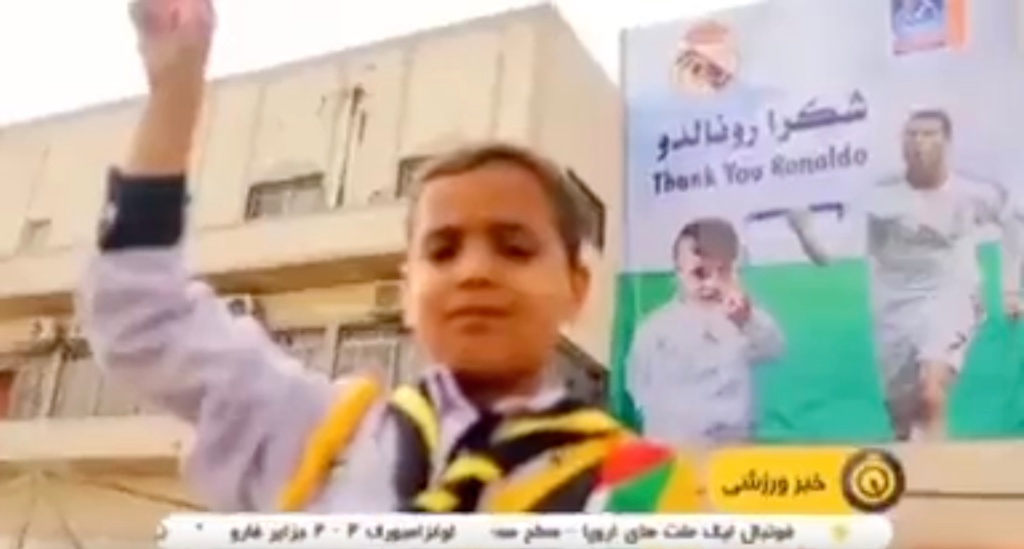
To illustrate this claim further, the Iranian channel broadcasted images of a poster in the Gaza Strip showing Ronaldo and the words “thank you Ronaldo” in English and Arabic. But these date back to 2016, when a Palestinian child, a victim of a fire, had visited the Real Madrid training camp to take pictures with the Portuguese star. These thank-you posters had indeed been put up in Gaza, but the context has nothing to do with IRIB’s claims.
A photo with Palestinian football officials
IRIB then showed a picture of Ronaldo and a group of others all wearing a scarf with the Palestinian flag. The report says: “He has become a target of corrupt officials because of his open and massive support for Palestine.”
This photo shows delegates from the Palestinian Football Association at FIFA. The man on the right is Jibril Rajoub, the president of the Palestinian Football Association. The scarf displays the flag of the Palestinian Football Association with its logo.
This is not a sign of support for the Palestinian cause. Ronaldo has also met many Israeli politicians and has given his jersey to Israel Katz, Israel’s foreign minister in 2019, or met Shimon Presse, former Israeli president in 2011.
This is a photo of Ronaldo offering his jersey to the Israeli foreign minister.
A clipped interview with Sepp Blatter
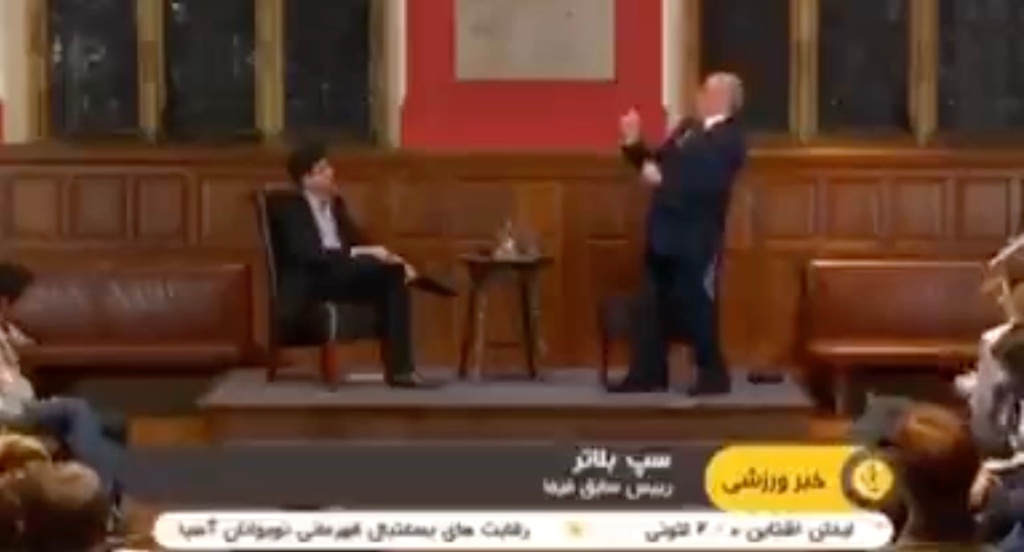
The report then includes a video of former FIFA president Sepp Blatter “reacting with anger and wrath because of Ronaldo’s support for the Palestinians” according to the Iranian journalist. According to IRIB, Blatter says: “Ronaldo acts like a little boss and wastes his money on his hair like the models”.
To find the original video, just use two keywords in Google: Sepp Blatter and Ronaldo, it appears in the first results.
This video of Blatter turns out to be an excerpt from his interview at Oxford University in 2013, when a journalist asks him who his favourite football player is between Messi and Ronaldo. Blatter praises both and says they are different.
In particular, in the excerpt taken and truncated by Iranian TV, he says: “Ronaldo is the commander of the field and it is good to have players like that, it gives life to football. One of them spends more money on his hair, but it doesn’t matter, I can’t say which one is better.”
Not an Israeli politician, but Italian
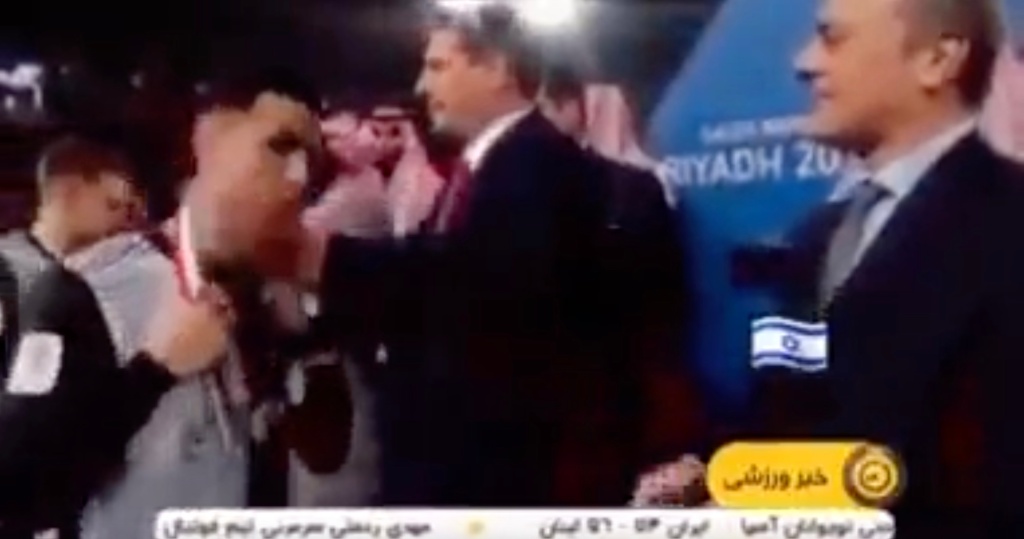
Further on, the Iranian channel claims that Ronaldo refuses to shake hands with an Israeli official “while refusing the president’s offer to visit Israel”.
In the video, there are clues to find the original: Ronaldo is wearing a Juventus shirt, the name of the Saudi capital Riyadh is written in the background and a year, 2019.
Typing “Saudi Arabia”, “football match” and “Juventus” into Google brings up a video of the Italian Super Cup final between Lazio and Juventus, played in Riyadh in 2019.
This scene of Ronaldo refusing to shake hands with an official occurred at the medal ceremony and the man in the suit was Luca Ferrari, an Italian politician, Italy’s ambassador to Saudi Arabia at the time, and now Italy’s ambassador to China.
Ronaldo, visibly angered by the defeat, immediately removed his silver medal and ignored Luca Ferrari’s hand.
Since there has never been an Israeli official in Saudi Arabia, as the two countries have no diplomatic relations, we can be sure that this claim by Iranian TV is false.
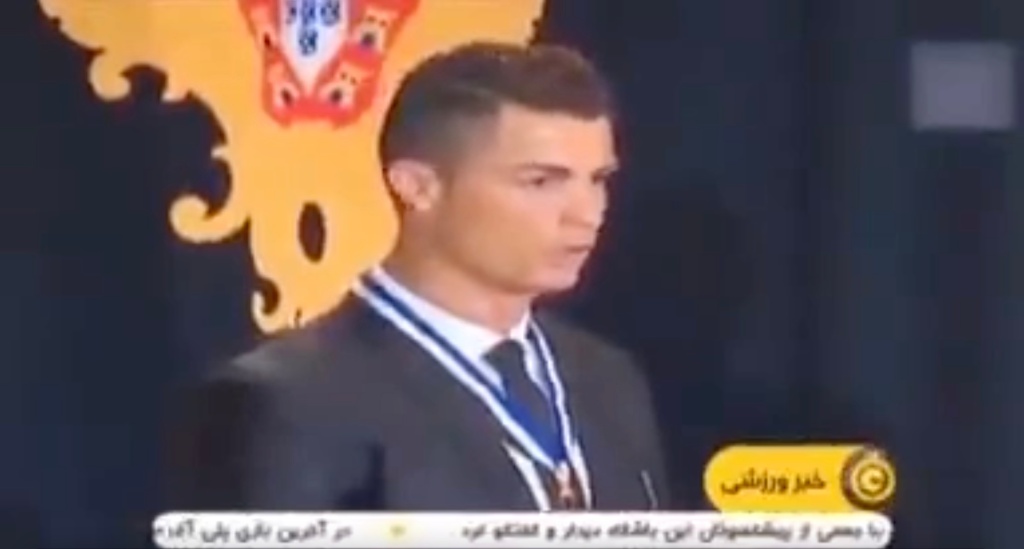
Not a speech against Israel, but a speech about accepting the Medal of Honour The Iranian state TV report continues with a speech by Ronaldo, over which a voice-over has been added, purporting to translate his words: “If I said even once that I love the Zionist occupation regime, FIFA would select me as the best football player, but I prefer to support the poor and hungry Palestinian children, rather than accept the Israeli invitation.”
This translation is once again completely wrong. We can find the original words via a reverse image search on Google.
This video was taken in January 2014, at an official ceremony in Lisbon where the player was receiving the distinction of “Grand Officer of the Order of the Infante Dom Henrique”, an honorary title in Portugal, awarded by Aníbal Cavaco Silva, Portuguese president at the time.
In his brief speech after receiving the award, he said: “I am very happy. Everyone I love is here, except my family who unfortunately could not attend this ceremony for personal and professional reasons. This is a very special moment for me and for all the Portuguese people who are here. I am extremely satisfied. I hope to continue on the path I have taken since the beginning of my career, to win trophies and to be successful both personally and as a team, and to achieve all this in the name of Portugal.”
No mention was made of Israel or Palestine.
Lorca earthquake survivors, not Palestinians
At the end of the report, Ronaldo appears with a banner that says: “Together with the Palestinians” alongside the Palestinian flag. This image was doctored.
Again, a reverse Google search finds the original photos and many more photos of the same campaign by other Real Madrid players with the same banner.
That campaign dates back to 2011: it was in support of the survivors of an earthquake in Lorca, Spain, which killed nine people. And the real banner displays a red and white ribbon, not a Palestinian flag.
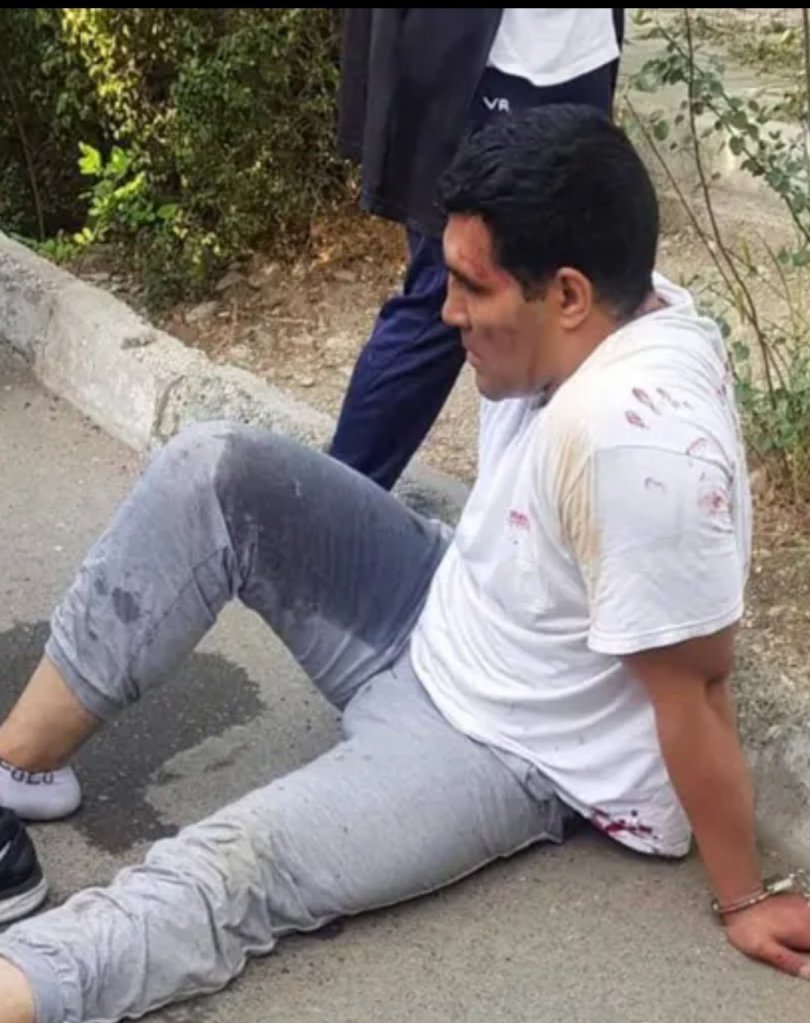
It all started as a citation for an improperly worn headscarf, but the incident escalated when former Iranian boxing champion Reza Moradkhani was shot four times by Iran’s “morality police” on April 28, after they questioned his wife. The incident, which left him severely injured, adds to the long list of abuses by the morality police, known for their brutal enforcement of a strict Islamic dress code.
Following the altercation with the morality police, known in Iran as the Gasht-e Ershad, Reza Moradkhani, a former member of the Iranian national boxing team and boxing champion in Asia, underwent 12 hours of surgery for his injuries and is now partially paralysed.
Moradkhani and his wife, Maria Arefi, also a boxer, submitted a lawsuit against the morality police officer after the shooting, saying that they were advised: “not to go public with the story”. But in June, the court dismissed their case and the couple went to the media.
Suddenly the officer took out his pepper spray and gassed my husband’
Arefi recounted the incident to Shargh, a popular reformist daily newspaper in Iran, on June 11.
We were walking in Pardisan Park, and suddenly a morality police van stopped next to us and a female officer said to me: “What’s your ID number? We want to verify if you have any moral offence records.”
I was shocked and told her to Google my name and my husband’s name to find out who we are. We are not criminals, there’s no need for an ID number. My husband was offended and asked, “What do you mean if my wife has a moral offence record?”
Then a male police officer came out of the van and told my husband, “Get away, it’s none of your business.” My husband answered, “She’s my wife and your officer is talking about my wife, what do you mean it’s not my business?” […]
To avoid any problems – especially because our one-year-old daughter was with us – we apologised, but the male officer insulted me. My husband asked him to be polite and suddenly the officer took out his pepper spray and gassed my husband.
My husband could not see at all and then we heard a gunshot. Then, the officer kept shooting while the other was shouting, “Don’t shoot, don’t shoot!” But the officer didn’t listen at all.
A video taken minutes after the shootings, published on June 11. In the video, people are shouting “ They shot at this woman and her husband. Help, help!”
یک ماه پیش مأمورهای گشت ارشاد برای همسر #رضا_مرادخانی مدال آور بوکس آسیا مزاحمت ایجاد کردند و سپس به خود رضا دوبار شلیک کردند، حالا با سناریو سازی، در حال سرپوش گذاشتن بر روی این پرونده هستند.
Toomaj, an Iranian rapper, wrote on Twitter, “A month ago, morality police officers shot at Reza, a boxing champion who was defending his wife. Now they are setting him up to end the process.”
‘The couple reported that, after the incident, the police officer confiscated cell phones from all nearby witnesses, deleting photos and videos of the shooting, even factory-resetting several phones to delete all their data. Only one photo and a short clip was taken after the incident have been recovered.
After the shooting, the victims say that Gasht-e Ershad officials, including the chief commander, personally apologised to them and said that their bills would be taken care of.
But the couple learned that the police filed charges against them for resisting arrest and not adhering to the proper Islamic dress code, thereby justifying their response. Arefi has denied the police’s claims that she was unveiled and wearing a short-sleeved shirt.
In Iran, it is a crime for women not to wear a headscarf in accordance with Islamic sharia. The Gasht-e Ershad morality police are tasked with strictly enforcing the observance of the dress code. Arefi could risk a two-month prison sentence and 74 lashes as punishment, according to the family’s lawyer.
However, she maintains that witnesses in the park, ambulance staff, as well as doctors and nurses at the hospital can attest that she was wearing proper attire on April 28.
Moradkhani was also accused of trying to take the officer’s pepper spray canister, a charge which could land him one to three years in prison.
The boxing champion told Shargh:
I earn my living through boxing. Now, I can’t fight or coach for at least a year due to my physical situation. All we want is justice, and for the police to recognise the truth and give the maximum legal punishment to this officer.
This is hardly the first time that Iran’s morality police have been accused of brutality and excessive force. Citizen journalists have captured incidents involving Gasht-e-Ershad and brought them into the public eye.
In 2018, a video that went viral around the world showed morality police assaulting a young woman who they say wasn’t wearing her hijab properly.
Since the hijab was deemed mandatory for women following the 1978-’79 Islamic revolution in Iran, some women have pushed back. Activists and everyday women have tried to defy the law through protests or by wearing outfits that push the boundaries of the Islamic republic’s dress codes.
In 2019 Iranian authorities condemned Saba Kord Afshari and Yasaman Aryani to five years in prison for their activism against compulsory hijab laws. Aryani’s mother, Monireh Arabshahi, is condemned to more than nine years of prison for the same charges.
The deadly collapse of a building under construction on May 23 in Abadan, a city in Iran’s Khuzestan province, has sparked a wave of outrage in the country. At least 41 people died in the tragedy and dozens are still missing. Two weeks after the collapse, hundreds of protestors blaming the authorities for negligence and corruption are still in the streets.
Iran’s Supreme Leader, Ayatollah Ali Khamenei, has called for those responsible for the tragedy to be prosecuted and punished. The regional judiciary also announced that it had arrested thirteen people, including the mayor of Abadan and two of its former mayors.
The protests, however, are not letting up. Protesters accuse the owner of the 10-storey building, Hossein Abdolbaghi, a businessman close to the government, of corruption. The unrest has spread to other towns across the southwestern region of Iran.
ویدیو دیگری از مقاومت مردم آبادان که ثانیه به ثانیهاش درخشان از شجاعت این مردم است. pic.twitter.com/KUrjOXKuc6
A member of the riot police beats protesters in Abadan, Iran. Video published on May 30.
Emergency workers are still pulling bodies from the rubble. On June 6, the death toll rose to 41, Iranian officials said, but they fear that more bodies have yet to be recovered. Residents worry that up to a hundred people may still be trapped under debris.
Footage of the collapse filmed from a shop near the building.
‘You have to dig and crawl under tonnes of gravel and cement to find the bodies’
The Iranian Red Crescent Society and fire brigade have been dispatched to help the victims. However, the search and rescue operations are mainly carried out by residents, according to our Observer, Leili (not her real name), an Iranian activist who lives in Abadan. After the building collapsed, she rushed to the site.
The bulk of the relief effort falls on the shoulders of the residents. The fire brigade and the Red Crescent seem overwhelmed. No one knows what is going on at the site. There is no clear rescue plan.
The fire brigade and the Red Crescent have told me that they don’t have enough equipment. They also told me that there was no one to give directions.
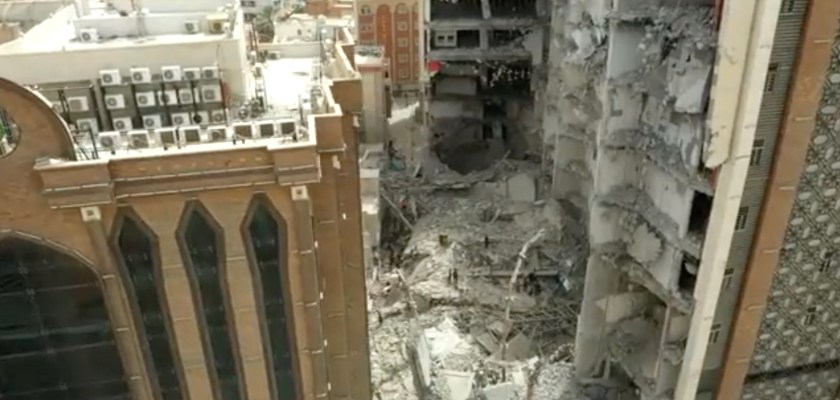
تصاویر هوایی منتشر شده از ساختمان ریزش کرده #متروپل_آبادان نگاه کنید به ارتفاع سازه، شرایط قرار گرفتن آن در مرکز شهر تا به ابعاد این فاجعه پی ببرید. فکر کنید بقیه این ساختمان آماده فرو ریختن است.#آبادان#متروپلpic.twitter.com/sS8tnzn5Kh
Aerial images of the building showing the extent of the damage.
What is worse is that the crisis management agency had ordered a large number of riot police to be deployed in the city, all of whom were dispatched from other regions. They have been all over the city since the building collapsed and even before the protests started.
This volunteer says that members of his family are trapped inside, and that no one is helping them. “The rescue teams are only there for the TV cameras,” he says. “Instead of sending the rescue team, they sent the riot police,” he adds in tears. Video published on May 26.
Volunteers tried to dig out survivors and bodies with rudimentary tools.
They brought all sorts of tools they thought would be useful: hacksaws, shovels and even pots to remove the gravel. And I must say that the volunteers have done and are still doing most of the work.
The rescue teams are working with big machines to clear the area, but that is a small part of the job. Because you have to dig and crawl under tons of gravel and cement to find the bodies. This has to be done by hand, not by machines, and this work is done by the volunteers, not the rescue groups. Brothers or fathers dig on their own to find their relatives’ bodies.
Volunteers use a cooking pot to clear gravel. Video published on May 24.
According to official documents published by local journalists, the body responsible for approving construction projects in Iran, the Construction Engineering Organization, has repeatedly indicated that the Metropol Building’s safety features were not up to standard. The organisation pointed out certain risks, including the addition of three extra floors to the building, which was already considered unstable. They have reported these irregularities to three successive mayors of the city and the city council since January 2022.
گویا مهندس ناظر #متروپل_آبادان که امروز فرو ریخت، دستور توقف عملیات اجرایی را داده ولی قدرت و نفوذ حسین عبدالباقی در آبادان به حدی است که گزارش ناظر بی اهمیت شمرده میشود و بهای آن را شهروندان مظلوم آبادانی با خون خود میدهند. واقعا شخص حسین عبدالباقی با چه جرعتی توانست pic.twitter.com/k4GgQk8p2n
A report by the Construction Engineering Organization, published by journalists, underlined the “unsafety of the building” and called for “suspension of construction”. The directive was never implemented. Photo published on May 23.
The building’s owner, Hossein Abdolbaghi, a wealthy businessman from the southwestern province of Khuzestan, is known to have links with high-ranking figures. In photos posted on his website, he is often seen with commanders of the Revolutionary Guard Corps or the governor of the province. Authorities initially said that Abdolbaghi had been arrested before announcing that he was inside the building when it collapsed and that he had died. Police said they were able to identify his body through DNA tests and identification documents found on the body. But many did not believe the announcement, our Observers in Iran told us.
A member of the riot police shoots at a protester. Published on May 28.
‘They used so much tear gas that rescue teams and volunteers had to suspend rescue operations’
People believe that the owner of the building was arrested, but was later killed to cover up important information about corruption.
The protests have been brutally repressed and many protesters have been arrested, including well-known activists. There are more and more people outside Abadan prison looking for their arrested relatives.
They shot at people with tear gas and beat them. They used so much tear gas that rescue teams and volunteers had to suspend rescue operations.
Protests have rocked the country for several weeks, particularly since the government lifted subsidies on flour and increased the prices of basic food items such as oil and dairy products.
‘The resentment and desire for change is widespread throughout the country’
Mahdi Hajati is an Iranian political analyst and former member of the Shiraz city council. He was arrested after revealing a network of corruption among city officials and protesting against the arrest of some Baháʼí citizens in Shiraz in 2018 and 2019. The Baháʼí faith has long been persecuted in the Islamic Republic of Iran. Hajati had to leave the country to avoid serving another prison term.
People have lost hope in any meaningful reform of the system. And when you look at the slogans of the last four years, you see that they are aimed at the system itself.
The protests, regardless of the direct cause and regardless of the region, have a single demand: regime change. The resentment and desire for change is widespread throughout the country.
Protesters in Abadan chant: “We made a mistake in carrying out the revolution”. They are referring to the 1978 Islamic Revolution that overthrew the Pahlavi dynasty.
‘People have said “Death to Khameini”‘ Hajati continued:
The slogans can be divided into three categories:
There are slogans that target the highest level of power: people have said “Death to Khamenei”, Iran’s supreme leader.
Others are against every pillar of the Islamic Republic’s ideology that relies on him. For example, they use the slogan: “No to Gaza, no to Palestine, we will sacrifice [only] for Iran”, or “Our enemy is here, they are lying, it is not America”.
The third part consists of slogans in favour of the Pahlavi dynasty [Editor’s note: The former ruler of Iran who was overthrown in the 1978 revolution by Islamists and leftist political groups].
در ویدیو گفته میشود: حالیأ الفلاحية يوم الثلاث: الان سهشنبه شادگان. ده خرداد ۱۴۰۱. pic.twitter.com/YZmjA0w4b1
Protests in Shadegan, a small town in southwestern Iran. Published on June 1.
The deep corruption is something that I observed firsthand myself. This demand for overthrowing the system is based on the common experiences of people like me, who thought we could make a change from the inside, until experience proved otherwise.
On May 19, female television hosts and journalists working in Afghan broadcasting received a new order from the Taliban: “Cover your face”. Our Observer, an Afghan TV presenter, explains how she received the order and how Afghan journalists have been resisting the Taliban’s resolve to “remove women from society”.
The Taliban’s Ministry for Promotion of Virtue and Prevention of Vice issued the order to female journalists around Afghanistan, to be observed from Saturday, May 21. The Taliban made it clear that “any female presenter who appeared on screen without covering her face must be given some other job or simply removed”, according to Sonia Niazi, a presenter with TOLOnews.
The day after the order came in, female journalists from three privately owned media companies in Afghanistan refused to comply, going on air with their faces visible. However, on May 22, they succumbed to the directive, citing “pressure and threats from the Taliban”, wearing a burqa or mask over the bottom half of their faces.
Many male journalists and TV presenters in Afghanistan began wearing black masks in solidarity with their female colleagues. The trend caught on around the world, with journalists from various countries posting photos of themselves wearing black masks using the hashtag #freeherface.
When the Taliban captured Kabul and solidified their control over Afghanistan on August 15, 2021, many Afghan journalists left the country or went into hiding, fearing Taliban persecution. Up to 257 media outlets shut their doors in only three months and many others reduced their staff. The first victims of this massive crackdown were women, many of whom had to stay at home, afraid of the Taliban’s reaction.
Female journalists wore black masks to cover their faces during a Taliban press conference on May 24.
On May 19, a TOLOnews anchorwoman published a video where she showed how she gets dressed in order to conform to the Taliban’s dress code. She first covers her hair with a scarf, which goes over a hat. She puts on tight sleeves to hide her arms and a long, oversized coat to hide the shape of her body. Yalda Ali published this video on her Facebook page, with the title “How I have to dress for today’s show”.
‘It was soul-crushing, I felt like they stole my identity
Yalda Ali is a host on TOLOnews. She told the me about her life as a well-known female journalist and presenter under Taliban rule.
“When the Taliban took Kabul, I decided to stay in Afghanistan because I heard that they would prosecute the families of journalists who left the country. I could not leave my family behind to endure this just because I wanted to run. I decided to stay, so that if the Taliban came looking for me, they would only arrest me and not bother my family. So I stood my ground.
In the two weeks after the Taliban took Kabul, our TV channel was shut down. After that, I heard that one of my male colleagues was going to start presenting “Bamdad-e-Khosh” [translation: Delighted Morning], the show that I used to host.
It greatly saddened me, I was crying. I thought: ‘that’s it’. They removed women from the scene and there would only be men from now on. All day I was thinking that if this could break my heart and could crush my hope about the future as a woman in Afghanistan, then I’m sure that many other women would have the same feeling when they saw that a man had replaced me.
That night, I called the television directors and told them I wanted my job back, I wanted to present my show. Fortunately, they accepted and I resumed my work.
Yalda Ali tweeted this photo of herself and one of her colleagues crying on May 20, 2022. “My smile is banned, my lips are banned, women are going to be banned soon,” she wrote.
I was the first female journalist to go back to her work and it wasn’t easy. It was horrifying and I was expecting them to come and arrest me at any moment, I covered my face at the checkpoints to hide my identity.
But I think it was a glimmer of hope for Afghan women to see me on TV screens. Every day I got messages from men and women saying how happy they are to see me on the show.
But it was with some compromises too. The Taliban had made it clear that women’s outfits on TV must conform to Islamic rules, as they define them.
I had to wear an all-over, oversize black coat to hide my ‘body’s curves’ and cover all my hair very carefully. Before, I used to wear colourful dresses and show my hair. Anything I wanted to wear was my choice.
Yalda Ali and one her colleagues from TOLOnews in May 2021, before the Taliban took the country.
It was like this until May 19. I was recording a promotional video for our show when the set manager came inside the studio and told me “I’m sorry but you have to wear a mask to cover your face”.
The directive came two weeks after the Taliban ordered all Afghan women to wear the full-coverage burqa in public places, prompting protests by some women’s rights activists.
‘It’s about our existence as women in society’
At first, I didn’t take it seriously – I thought it was a joke. But the TV director came in with a piece of paper in his hand and confirmed it was real and definitive. I was the first host that had to do this.
It was soul-crushing, I felt like they stole my identity. They are obliterating me as an independent human being and as a woman.
Journalists on TOLOnews and Shemshad TV wore black masks to present on May 24.
There was a battle inside me over whether I should follow the order or not. But I think, in the end, our fight with them is more complex than what women wear or the freedom of our personal choices. It’s about our existence as women in society. It’s about me just being present on a TV set.
And if this depends on covering my face, then let it be. I won’t give up. I will hold on and resist, in order to stay on the scene until the end. I will keep going no matter what to keep this flame lit – to keep alive the hope, willpower, and determination to fight for our rights as Afghan women.
If I give up now, the Taliban would achieve their ultimate goal, which means removing women totally from society, and I won’t let them do that.
The presence of Afghan women in society has already been diminished and we are the last ones who are resisting. But I feel it will not end here. They will ban women’s presence in the media or any other public space sooner or later, I’m sure of that. And what I’ll do on that day, honestly I have no idea.
Since the Taliban took over, I’ve risked my life and my family’s lives too. The day that they ban my presence on the TV, I will have no more reason to stay here. The only thing that I think these days is that Afghan women will not give up. We fight for our rights and our freedom and I hope that the world does not forget us.
The Taliban has a long history of violence against journalists, particularly female journalists. Since their takeover in August 2021, at least 50 journalists and media employees have been detained or arrested, often violently, for several hours up to nearly a week, according to Reporters Without Borders.
In 2021, Afghanistan was the deadliest country for journalists, with nine journalists having lost their lives.
On May 7, the Taliban ordered all Afghan women to wear the full-coverage burqa in public places. Since the decree was put in place, the difference in Afghanistan’s streets is visible. Or rather it’s invisible: women have all but deserted public streets to remain cloistered in their homes. Although our Observer dared to leave home to protest with other women’s rights activists on May 10, she has no illusions about the future that awaits her.
“Those women who are not too old or young must cover their face, except the eyes, as per sharia directives, in order to avoid provocation when meeting men who are not mahram (adult close male relatives),” says the decree, which came into force on May 7, announced by Taliban leader, Hibatullah Akhundzada.
The images of daily life in Kabul, Herat or Mazar-e Sharif on social media show that the order has been followed: women seem to be absent from the streets, markets and parks.
Video shot in Kabul, on May 19, 2022. No women are visible.
Akhundzada specified the consequences for breaking this decree on May 6: “First, the woman wearing immoral clothes will be punished; second, her husband will be summoned and detained for three days, and if he works in the public sector, he will be fired.”
The decree states that the best type of covering for women is the blue chadari, a type of full-length veil that was first imposed by the Taliban when they were in power between 1996 and 2001.
On May 10, however, women protested in the streets of Kabul. Wearing less conservative veils than required by the new law, they chanted, “The burqa is not our hijab.”
‘Public spaces are being emptied of women’
Lena (not her real name) is a young Afghan woman who has decided to wear the burqa so that she can continue to go out.
Since the announcement by the Taliban, I have been wearing the blue chadari. Before, I used to wear a veil on my head and a long coat, like many other young women. Now, if I don’t wear the chadari, I will have to stay at home, which is not an option. I want to walk in the streets and parks, I want to see my friends, this may be the last chance we have as women in Afghanistan to have fun.
But it is clear that since the decree, I see fewer and fewer women outside. Public spaces are being emptied of women. As long as you wear the chadari, the Taliban won’t give you any trouble.
But the smallest detail can cause headaches. A few days ago I was in a park. There were some teenage girls eating an ice cream, which obviously is not possible with a chadri. Some Taliban members came and asked them to wear their chadari properly. At first they tried to ignore them, but eventually they agreed.
However, I noticed that the Taliban were looking around, as if they were afraid of being recorded. As one of them was about to hit the girls, the other one told him, ‘No, no, someone might film it and I don’t want to get in trouble’. They want to continue to look good in appearance, so as not to interrupt their efforts to gain international recognition. But I think the future looks bleak.
جلوگیری طالبان از ورود دختران روسری رنگی به دانشگاه!
نیروهای امارت #طالبان روز چهارشنبه( ۲۸ ثور) در ورودی دانشگاه تعلیم و تربیه در #کابل، مانع ورود دختران شدند.
افراد امارت طالبان دخترانی را که روسری یا لباس رنگی پوشیده بودند از ورود به دانشگاه منع کردند و فقط به کسانی که… pic.twitter.com/BW0C12JCAH
Video shot at Kabul University, May 19, 2022. The Taliban banned students wearing coloured veils from entering.
Since their return to power in mid-August 2021, the Taliban have been trying to gain recognition from the international community, including Western countries, which have frozen millions of dollars placed in Afghan banks by the former Afghan government. Western countries were also the country’s biggest donors during the 20 years between the two Taliban regimes.
‘I would accept wearing a burqa if they let women study and work, but they won’t’
Ziba (not her real name) is an activist for women’s rights in Afghanistan. She lives in the north of the country.
Since the Taliban took over the country, I have been wearing the burqa, even before they made it mandatory. I did it for my own safety, on the one hand, and on the other hand, not to be recognised as an activist. It keeps them away from me.
The bitter reality, as an activist, is that, yes, women dared to protest in Kabul on May 10. But from the first day after the return of the Taliban, women have protested, and in the end nothing changed. The women who could left the country, and we are stuck here, desperate, our sprits crushed.
Personally, I would accept wearing a burqa if they let women study and work, but they won’t. We are not human beings here anymore. [Editor’s note: School is forbidden for girls after the age of 13.]
I don’t go out that much, I basically stay at home, like most women, I guess. I can confirm that there are fewer and fewer women on the streets here. I think it’s the younger generation who are more unwilling to play by the rules, to wear the burqa and stay at home.
I am afraid that the situation will only get worse. I’m afraid that one day the Taliban will simply ban women from going out. And we will have no one to turn to.
Our Observer’s fear is not unfounded: Akhundzada specified on May 6 that women “should stay at home, except in case of urgent need”.
According to the Georgetown Institute for Women, Peace and Security, Afghanistan is the worst country in the world for women, ahead of Syria and Yemen.
Iran’s Covid-19 vaccination campaign has been rife with complications: videos shared online show queues up to a hundred metres long as people wait for hours to be vaccinated, with doses sometimes running out long before everyone receives their jab. Others show thousands of people rushing to the border with Armenia in search of a dose. According to our Observer, an Iranian doctor, these predicaments are the result of political rivalries and the failure of Iran’s vaccine strategy.
In Iran, a country of 82 million people, only 4.7 million people have received their first dose of the Covid-19 vaccine, while just 2.2 million are fully vaccinated. So far, people 60 years of age and older are the only ones eligible for vaccination. Videos shared online show elderly men and women waiting in line for hours before they can get vaccinated.
میگویند، گفتند همه بيايند ایران مال و با هر سِنی #واكسن بزنند. بعد که همه رفتند و صف کشیدند، گفتند : "نه فقط همان ۸۰ و ۷۵ ساله ها! پس این صف راه انداختن برای چه بود؟ pic.twitter.com/BRHK14Bff7
A Video Published On May 21 On Twitter Shows Elderly Men And Women Waiting In A Long Queue In Front Of A Vaccination Provider.
Many others – mostly young, middle-class Iranians who are not yet eligible for vaccination and don’t expect to receive their vaccines in Iran anytime soon – have found their solution abroad, either in Dubai or Armenia, the northwestern neighbour of Iran which is easily reached by plane or car.
هر روز بیش از پیش بر تعداد #زنان عصبانی از این حکومت متوحش و متحجر که بیش از چهاردهه فقط و فقط به کشتار جامعه #ایران پرداخته افزوده میشود، زنان در صف مقدم جنبش سرنگونی جمهوری اسلامی هستند. pic.twitter.com/ia9gWqJQc7
A video published on Twitter on July 12 shows a group of people who have become angry after waiting for hours for their vaccine.
According to official numbers, which many experts suggest are largely underestimated, 86,000 Iranians have lost their lives to Covid-19. The country was severely impacted by a fifth wave of the pandemic, exacerbated by the spread of the Delta variant.
Since December 2020, Iranian political leaders have been promising to unroll a mass vaccination campaign using domestically produced vaccines. Iran’s health ministry said they would be providing Iranian vaccines starting this spring. But so far, the vaccines available to Iranians have been Sputnik V from Russia, Sinovac and Sinopharm from China and AstraZeneca vaccines produced in India.
But supplies have not been sufficient to meet the demand for vaccines in Iran. On July 10, Iran’s Health Minister Saeed Namaki announced, “From tomorrow, we will inject 400,000 vaccines each day.” However, according to Iranian media, only around 51,000 doses have been administered daily since then.
Iranian police pushed and hit an elderly man who was waiting in the queue for a vaccine. Video published on YouTube on June 27.
Vaccination has become a political and economic power struggle and rivalry’
Dr. Hadi Yazdani is a physician based in Shiraz, in central Iran. He told the FRANCE 24 Observers why Iran has been seeing a vaccine shortage:
There are a few different factors involved in the vaccination crisis in Iran. On one hand, there is a general problem in the world: there are a limited number of vaccines globally, and countries like India, China and Russia that have promised to provide vaccines to Iran, refused to sell them in the end [Editor’s note: either due to insufficient supply or higher bidding countries].
The Islamic Republic has never tried to establish a normal relationship with the world and, in crisis periods like this, they are not able to ask for any favours
ملت «ابرقدرت منطقه» پشت گیت ورود به ارمنستان صف کشیدهاند تا واکسن بزنند. همان ابرقدرتی که تا الان ۸ – ۷ واکسن تولید کرده! این تصاویر لکه ننگیست بر پیشانی آنها که تمام شئون مملکت را کردهاند عرصه کلکلهای ابلهانه با غرب و خواستند ژست «تولید داخلی» بگیرند و جیب مافیا را پر کنند! pic.twitter.com/piF241GyB4
Iranians at the border checkpoint between Iran and Armenia, trying to enter Armenia for a vaccine. Video published on Twitter on July 10.
But the main problem lies somewhere else: some powerful and well-connected parties have managed to convince political leaders that we don’t need foreign vaccines and have blocked foreign vaccine purchases in large quantities.
These groups are powerful and well-connected. They even have pull with the most powerful official in Iran, the Supreme Leader. Supreme Leader Ali Khamenei, during a short speech in January 2021, banned “western-made vaccines” from the United States, United Kingdom and even France [Editor’s note: France is developing a Sanofi-GSK vaccine which is not yet in distribution].
Eighteen different Iranian companies have submitted their vaccine licenses in Iran. If we look closely, only two or three companies are scientific ones, the others belong to different political and power factions in Iran. The most important group among them is the Executive Headquarters of Imam’s Directive, also known as Setad, which is making the COVIran Barekat vaccine.
Setad is one of the most powerful and richest semi-governmental bodies in Iran, created in 1989 by Rohollah Khomeini, founder of the Islamic Republic, and now directly controlled by current Supreme Leader Ali Khamenei. Setad, which is valued at around $95 billion, was sanctioned by former US President Donald Trump in June 2019. Setad has promised to provide more than 50 million Barekat vaccines by September 2021, but so far, none have been delivered
‘So far, all they have given to people are just words’
Dr Hadi Yazdani continued:
Vaccination has become a political and economic power struggle and rivalry in Iran. These factions have realised that the Covid-19 vaccination is something that might need to be readministered every year or so. In this case, they look at it as a huge and endless source of money. So they tried to encourage nationalism for “made-in-Iran” products in the vaccination campaign to just fill their pockets.
And so far, all they have given to people are just words. We have not seen any vaccines and there is no available data to verify the efficiency of these so-called made-in-Iran vaccines. Even if these vaccines really work and are effective, there are serious questions about Iran’s ability to produce them in industrial quantities.
Thanks to this vaccination policy or, rather, lack of policy, there has already been a fifth wave of Covid-19 in Iran and, if the situation continues like this, we will have many other waves one after the other.
‘The queues to cross the border to get vaccines are humiliating’
There is, as of yet, no data concerning the number of Iranians who have fled to Dubai or Armenia to get vaccinated, however, Iran’s customs office announced on July 10 that “in the past 48 hours, 1,800 Iranians have crossed the border checkpoint between the two countries”.
Dr. Hadi Yazdani continued:
It’s just normal people who feel that they have been left alone in face of the multiple deadly waves of Covid-19 and have no hope to get the vaccine in their country any time soon, who go to try and find a vaccine anywhere they can. Armenia is one possibility: it’s a neighboring country, it’s not expensive and they have enough doses.
The queues to cross the border to get vaccines there are, in one word, humiliating. As an Iranian, when I see that our government is not capable of exercising its basic duties, providing mental and physical health services and security to its citizens, I feel nothing but humiliation.
On July 7, the Armenian Ambassador to Iran Artashes Tumanyan announced that vaccination in Armenia will be free. However, only tourists who stay in the country for more than 10 days can receive the vaccine.












 Ershad Alijani