All posts filed under: Iran

Left: An Iranian dancer practises pole-dancing in a private underground venue. Right: Another Iranian woman performs aerial dance in a women-only gym. In a country where women are banned from riding motorbikes, singing or dancing in public and appearing in public without a hijab, both aerial and pole dance are acts of defiance and, for many, forms of resistance.

‘It’s feminist and it’s badass’: the Iranian women taking up pole dancing and aerial dance

Hanging from a rope, a harness or a hoop, Iranian women are flocking to gyms to perform aerial dance and sharing videos of their routines on social media. Others are quietly practising another form of self-expression – pole-dancing – in underground venues hidden from Iran’s security forces. In a theocracy where women are banned from riding motorbikes, singing in public or appearing outside without a hijab, aerial dance and pole dancing are revolutionary acts. Nearly three years after the death of Mahsa Amini kicked off the “Woman Life Freedom” protests, women’s gyms across Iran are offering a new sport: aerial dancing, or “aerial” for short. The demand is so high that, as one coach puts it, “you can’t find a gym without an aerial class”. Aerial dance is a form of acrobatic performance that has gained popularity around the world since the 1970s. It involves dancers executing athletic and artistic movements while suspended in the air, hanging from an apparatus such as a rope, a hoop, or a horizontal bar. In order to avoid repression by Iran’s Islamic regime, promoters of aerial dance …
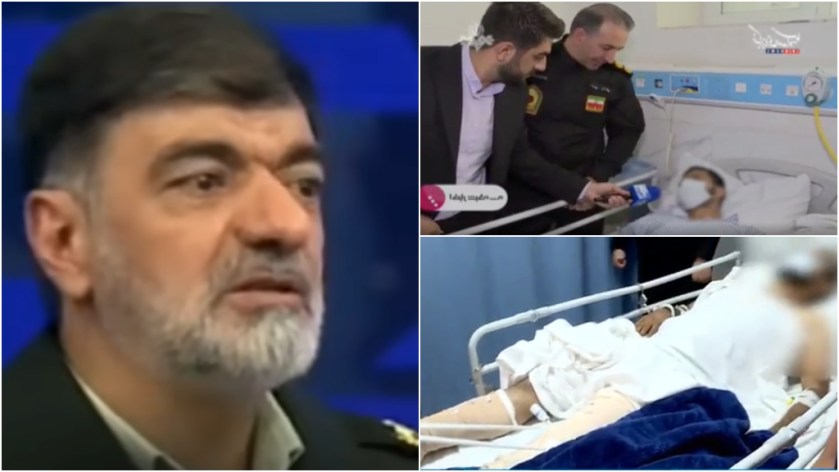
“From now on, we will shoot the thugs,” promised Iran's notorious police chief, Ahmad-Reza Radan. Since then, state media have regularly shown videos of police officers arresting alleged “thugs” who have been shot, usually in one or both legs.

‘We will shoot the thugs’: Iranian police crack down on crime

“From now on, we will shoot the thugs,” promised Iran’s notorious police chief, Ahmad-Reza Radan, in an interview with the media in April 2025. Since then, state media have regularly shown videos of police officers posing with alleged “thugs” they have arrested, saying they have been shot, usually in one or both legs. The Iranian police are responding to growing criticism of the increase in crime and violence, which some Iranian sociologists believe is due to poverty, trauma and daily stress caused by political unrest and mistrust of institutions. Images of violent attacks and robberies have become ubiquitous in Iran, with multiple videos recorded by CCTV cameras or mobile phones posted daily on social media.   Some of the attacks result in the victim’s death, such as an incident on February 12, when two thieves attacked a Tehran University student, stabbing him in the neck while stealing his backpack. The student, Amir Khaleghi, died in hospital. CCTV footage of the attack triggered several days of protests and strikes at Tehran University. Some days later, Tehran police claimed …

Propaganda slip-up: Iran accidentally exposes sensitive missile data

On May 4, 2025, Tehran announced it had tested a new ballistic missile system. Iranian state television swiftly began broadcasting propaganda videos showcasing the test. However, there was a minor oversight: one of the propaganda videos posted on social media inadvertently revealed on-screen data showing the missile’s drag coefficient, a sensitive piece of information that could make it easier for Iran’s enemies to block the missiles. The new ballistic missile, named “Qasem Basir”, is the latest addition to Tehran’s extensive family of ballistic missiles. It has a range of 1,300km, a lightweight carbon fibre body along with a 500kg warhead, and a camera to ensure precise targeting. Brigadier General Aziz Nasirzadeh, Iran’s defence minister, who appeared prominently in the propaganda footage, claimed that the new missile system was developed based on experiences gained during two recent Iranian missile attacks against Israel in April and October 2024. “No defence system, neither THAAD nor Patriot, is capable of intercepting Qasem Basir missiles,” Nasirzadeh asserted. In the version aired on television by state broadcasters, the image from the missile’s camera …

Iranian female singers face arrests and police summons

In Iran, at least seven women have recently been arrested or summoned for questioning by police. The Iranian regime does not allow women to sing in public. However, more and more Iranian women are defying the ban, particularly since the “Woman Life Freedom” movement began. In recent weeks, they have been the target of a crackdown. This report aired and was published first here at France 24.

Vanishing reservoirs, empty taps: how Iran’s water crisis became a national emergency

In recent days, images of vast, dried-up reservoirs near Tehran have circulated on social media. These dams supply water to more than nine million people in the Iranian capital, and their depletion has sparked widespread concern. A combination of decades of drought, mismanagement, and crumbling infrastructure is driving Iran towards an unprecedented water crisis as the Middle East enters its warm season, experts warn. A video of the Amir Kabir Dam, 30 km northwest of Tehran, taken in August 2024 shows clear blue water reaching up into the hills. In a video from the same vantage point in March 2025, the water has disappeared, replaced by a cracked, desolate lake bed. Another video being widely shared by Iranians shows a group of motorcyclists driving on the muddy bed of the Latyan Dam reservoir, 15 km northeast of the capital. “You’d be shocked if you knew this was the bed of the Latyan reservoir,” the caption reads. Tehran is on the brink of running out of water. Authorities are preparing to introduce rationing, with daily supply …

“It will be our execution order”: US deportations leave asylum seekers in limbo

An Iranian woman who was among 299 migrants deported by the United States to Panama has appealed to President Donald Trump for a reprieve so she can avoid being sent back to Iran. As a Christian convert, Artemis Ghasemzadeh, 27, could face execution or life in prison under Iran’s Sharia law if she is forced to return. UPDATE: On Thursday night, all the asylum seekers, including Artemis, were transferred to a camp in the jungle of Darién, near the Panama-Colombia border. Since then, we have lost contact with her. Speaking to me from the hotel in Panama City where the migrants are being held, Artemis Ghasemzadeh said: “Our first request is a reprieve from President Trump – just for our cases to be reviewed.” Ghasemzadeh said US officials had confiscated many of the deportees’ phones and that she was the only one talking to the media: “Everyone, really everyone, has asked me to say please do not deport us to our country of origin.” The Iranians were among the first group of 119 people flown to Panama on a US Army …

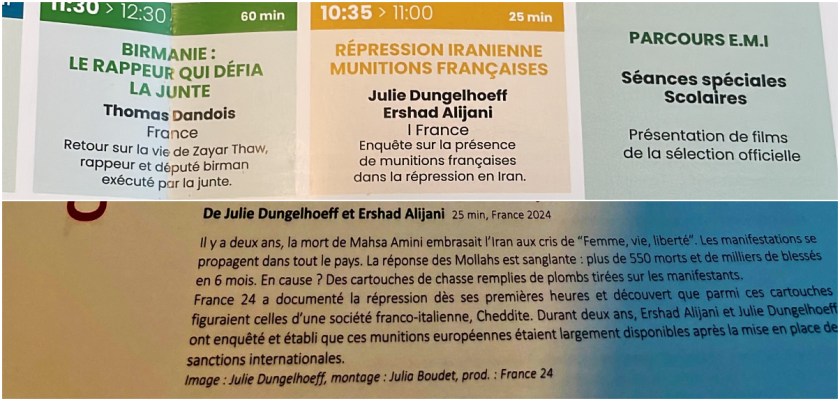
FIGRA 2025: Our Investigation on French-Made Ammunition in Iran Nominatedin Documentary Competition

I am thrilled to announce that “Repression in Iran, Ammunition Made in France“, the investigation I conducted with my esteemed colleague Julie Dungelhoef, has been selected for the 32nd FIGRA Festival in the documentary competition (under 40 minutes). This two-year investigation uncovered how French-made shotgun shells ended up in Iran and were used against Woman, Life, Freedom protesters—despite international sanctions. Shedding light on this injustice would not have been possible without the courage of Iranians who sent us hundreds of photos and the bravery of Elaheh and Sima, two victims of shotgun fire, who shared their harrowing experiences.

Repression in Iran, ammunition made in France

A two-year investigation by FRANCE 24 has revealed that hunting cartridges produced by the French-Italian ammunition manufacturer Cheddite were used in Iran during the violent crackdown on the “Woman, Life, Freedom” protests in 2022. The investigation uncovers how these cartridges are widely available in Iran, despite European sanctions imposed in 2011. It appears the ammunition may have been routed through Turkey, where Cheddite at one point held shares in a weapons manufacturing company. This investigation, broadcast by FRANCE 24, sheds light on the dealings that allowed the ammunition to reach Iranian soil, despite international sanctions. This investigation was produced by Ershad Alijani and Jullie Dungeloef. You can watch it on YouTube above and read the full story here on France24.

‘Schools are responsible’: Iran’s student suicides highlight growing tensions over its hijab laws

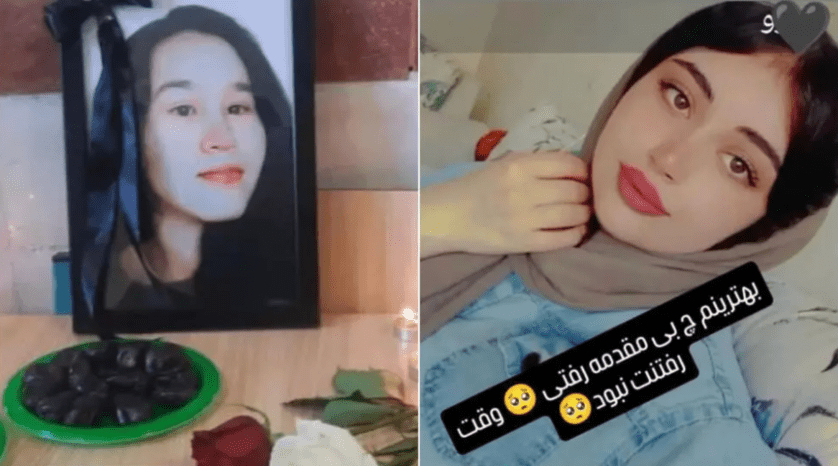
The enforcement of hijab rules in Iran is once again making tragic headlines. Over the past two weeks, two teenage girls took their own lives after reportedly facing intense pressure in their schools. Sixteen-year-old Arezou Khavari jumped from a building, and 17-year-old Ainaz Karimi hanged herself. Both were students at public schools in impoverished regions of the country. According to Iranian teachers interviewed by me, the country’s education system is structured to exert relentless pressure on students – particularly young girls – to conform to the strict dictates of Islamic Sharia law. While news of student suicides occasionally surfaces in Iranian media for various reasons, this is the first reported instance of two teenage girls taking their lives specifically due to pressure over the hijab. The incidents have sparked fresh outrage across Iranian society. On October 27, Ainaz Karimi, 17, took her own life in a village near Kazerun, in southwestern Iran. She had reportedly been insulted, humiliated in front of her classmates, and threatened with expulsion for wearing nail polish and dyeing her hair. As punishment, she was banned from attending classes …

Iranian television broadcasts barrage of misinformation to present Ronaldo as pro-Palestine

With eight textbook examples of misinformation in just two minutes, the Iranian public television channel IRIB broadcast a report on the football superstar Cristiano Ronaldo on June 15. The report made it seem like Ronaldo is a champion of the Palestinian cause, while expressing his “hatred” for Israel. But in reality, the story was rife with disinformation and crudely edited. Television programs in Iran are state-run, and most of them promote the ideology and policies of the country’s supreme leader, Ali Khamenei, who personally appoints the heads of each channel. Many Iranians, aware of the propaganda broadcast on state TV, turn to Persian channels from abroad that are available via satellite. On June 15, it was one of these state-run TV channels, IRIB, broadcast a report in Persian about Cristiano Ronaldo and his supposed support for the Palestinian cause. In the two-minute report, we counted no less than eight falsehoods… which we’ll take a closer look at in this article. Playing against Iceland, not Israel First off, the report claims that the captain of the …