All posts tagged: Art

Left: An Iranian dancer practises pole-dancing in a private underground venue. Right: Another Iranian woman performs aerial dance in a women-only gym. In a country where women are banned from riding motorbikes, singing or dancing in public and appearing in public without a hijab, both aerial and pole dance are acts of defiance and, for many, forms of resistance.

‘It’s feminist and it’s badass’: the Iranian women taking up pole dancing and aerial dance

Hanging from a rope, a harness or a hoop, Iranian women are flocking to gyms to perform aerial dance and sharing videos of their routines on social media. Others are quietly practising another form of self-expression – pole-dancing – in underground venues hidden from Iran’s security forces. In a theocracy where women are banned from riding motorbikes, singing in public or appearing outside without a hijab, aerial dance and pole dancing are revolutionary acts. Nearly three years after the death of Mahsa Amini kicked off the “Woman Life Freedom” protests, women’s gyms across Iran are offering a new sport: aerial dancing, or “aerial” for short. The demand is so high that, as one coach puts it, “you can’t find a gym without an aerial class”. Aerial dance is a form of acrobatic performance that has gained popularity around the world since the 1970s. It involves dancers executing athletic and artistic movements while suspended in the air, hanging from an apparatus such as a rope, a hoop, or a horizontal bar. In order to avoid repression by Iran’s Islamic regime, promoters of aerial dance …

Iranian female singers face arrests and police summons

In Iran, at least seven women have recently been arrested or summoned for questioning by police. The Iranian regime does not allow women to sing in public. However, more and more Iranian women are defying the ban, particularly since the “Woman Life Freedom” movement began. In recent weeks, they have been the target of a crackdown. This report aired and was published first here at France 24.

Iranian influencer poses with skulls, artifacts in an unexplored archeological site

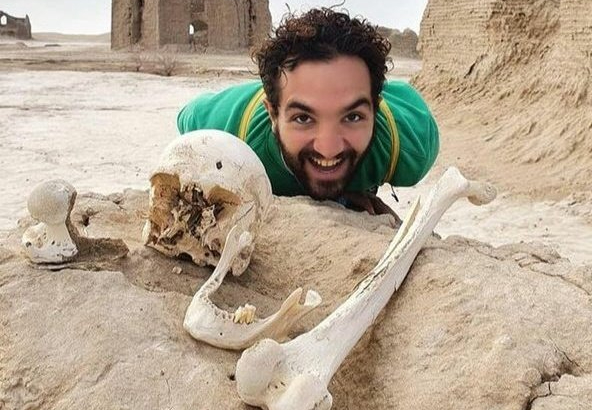
Iranian Instagram influencer Soheil Taghavi posed with skulls, bones, and pieces of pottery at the unexplored Tasuki archeological site in southeast Iran in a video that he hoped would go viral. But many people across Iran were shocked by the video, especially lovers of history and archeology. Our Observer explains that even moving the smallest object in this kind of site can jeopardize future digs and ruin important discoveries about the past. On Instagram, Soheil Taghavi describes himself as a tour guide. He has 29,000 followers. In the videos that he posted of his visit to the Tasuki archeological site, Taghavi digs in the ground and pulls out skulls and bones, then poses with them in front of the camera. “I gathered up the best preserved pieces for you”, he says at one point. “Now is the moment to share my page so your friends can see these cool things, too,” he says, smiling. ‘Just touching these artefacts with bare hands could damage them’ Fatemeh Aliasghar is an Iranian journalist who has written extensively about …

An Iranian film director on the country’s censorship laws (1/2)

The Iranian film industry is one of the most respected in the world and wins dozens of international prizes each year. However, before they are released, films produced in Iran must go in front of the state censorship board. I spoke with Iranian director Abdolreza Kahani to find out the real deal about making movies in a theocracy. I’m going to publish a two-part interview about censorship and Iranian cinema. Stay tuned for part two. How does censorship work in Iran? In the past decade, at least 25 films have been banned in Iran, for a variety of reasons. The film “Asabani Nistam” (“I’m not angry”, in English) by director Reza Dormishian was banned in 2014 because the story centres on the Green movement, an opposition movement that came to prominence in 2009. The films “Mehmoonie Kami” (“Kami’s Party”) by director Ali Ahmadzadeh and “Delighted” by Abdolreza Kahani, which are both about social tension in Iran, were also banned. “To get authorisation to film in Iran, you need to go through several steps” However, it’s …