A video showing two young boys being mistreated by a municipal worker has caused an uproar in Iran. The image is shocking: the man filming asks the boys to eat the flowers that they were selling in the street – or face deportation. Read More
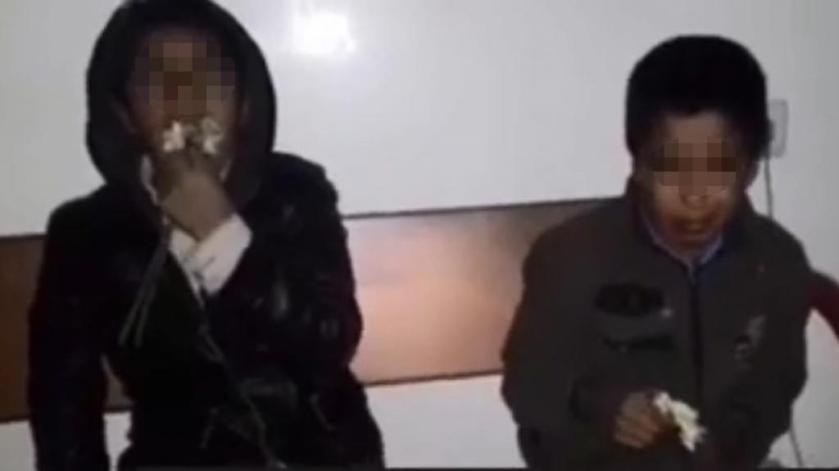
A video showing two young boys being mistreated by a municipal worker has caused an uproar in Iran. The image is shocking: the man filming asks the boys to eat the flowers that they were selling in the street – or face deportation. Read More

In Iran, a drowning lizard was saved by forest rangers who gave it mouth-to-mouth resuscitation.
And that’s not all – Iranian rangers have also raised funds through Instagram to help save thousands of animals from drought!
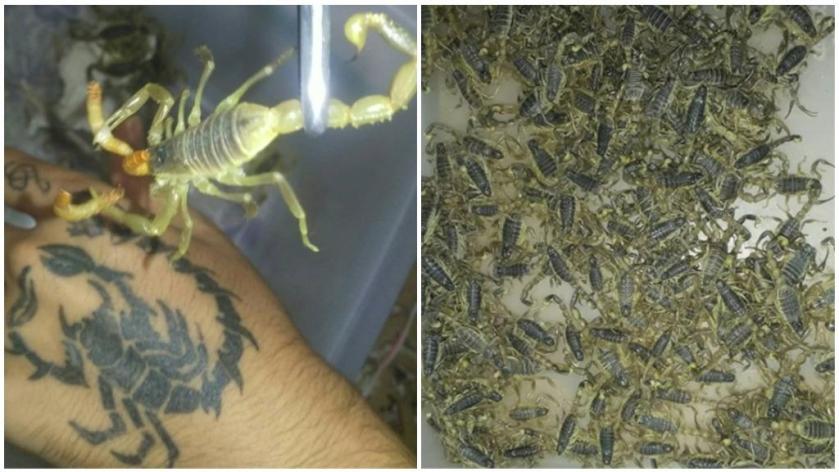
It’s a get-rich-quick scheme that stings. In quite a few countries, but particularly in Iran, people are trying to turn scorpion’s venom into fortunes. They’ve invested time and Read More

While alcohol has been illegal in Iran since the Islamic Republic’s creation in 1979, liquor is readily available on the black market, whether it’s smuggled from abroad or produced by local bootleggers. Read More

I participated recently in a debate on France24 about Iran and France relation after Paris has frozen assets of Iran’s intelligence services over alleged bomb plot by Tehran.
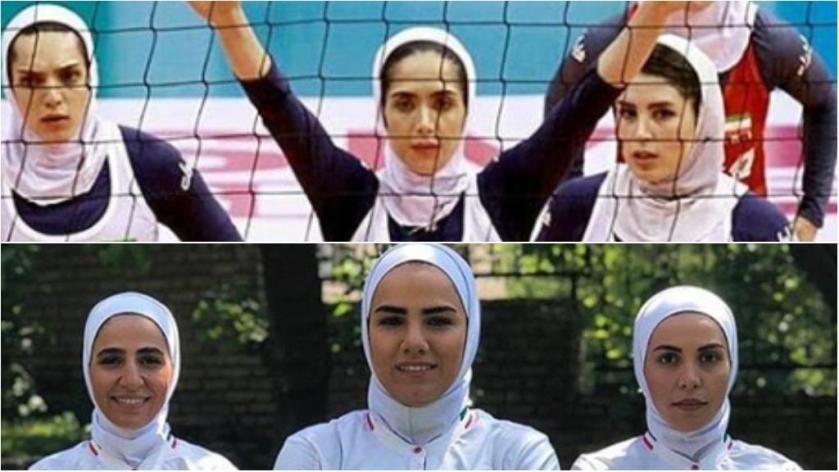
In Iran, TV channels – which are all state-run – do not broadcast most women’s sports competitions due to restrictions on showing women’s bodies. But thanks to social media, Iranian women are covering women’s sports themselves. Read More

Three videos circulating on social networks in Afghanistan claim to show a “prayer-writing” mullah sexually assaulting three separate women. The videos were reportedly made three years ago in the north-central Faryab province, but appeared online the week of September 10. Local officials have identified the mullah and accused him of rape. If the charges are correct, these videos would be rare documentation of an often-alleged practice: rape committed by mullahs claiming to offer prayer-inspired healing to women.
They are known as “taweez nevis” in Afghanistan: self-appointed mullahs who in return for money write prayers on paper that are supposed to serve as “charms” (taweez). Afghan families often send women to see them in case of marital problems such as infertility. The sessions often lead to abuse.
The three videos sent to me by multiple sources in Afghanistan appear to show such abuse. They show the same man, with a long beard and white robes, alone with three different women, in each case lying on a mattress on the floor.
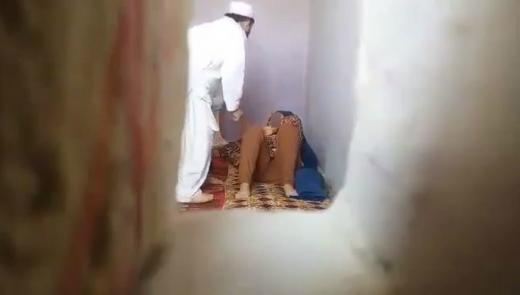
In the first video, which lasts 3:43, the man and the woman remain clothed as he kneels between the woman’s legs and rubs himself against her. In the second, with a duration of 2:33, both are clothed and he appears to hold an object between her legs; then both stand up, he touches her genital area, then raises her shirt and kisses her midriff. In the third video, duration 2:14, he removes the woman’s trousers and his own and they have intercourse.
Observers in Afghanistan who have seen the videos say the man’s appearance and behaviour suggest that he is a “taweez nevis.” They note that he is heard reciting Islamic prayers as he touches the women. While most of his words are inaudible, the phrase in Arabic “There is no God but God” can be clearly heard.
Local officials identify mullah seen in videos
Local officials have identified the man in the video as a mullah who is wanted by the authorities. Naqibollah Faeq, governor of Faryab province, told France 24 he had already seen the videos:
“They were filmed three years ago, in a village in the province, by a mullah called Rasoul Landi. He forced women to have sex with him, and threatened to publish the videos if they denounced him. Someone got ahold of his telephone two years ago and blackmailed him for months, extorting a lot of money. Landi eventually fled to Turkey about 18 months ago. That was then the videos started circulating, from phone to phone.
The videos showed up online a few days ago, along with rumours that Landi is back in Afghanistan. We are trying to track him down. The problem is, no one has filed a complaint against him. We are extremely worried for the safety of the women in the videos – their faces are clearly visible. If someone identifies them, they are dead.
Instead of condemning ‘taweez nevis’ mullahs, and revoking their religious status, clerics in Afghanistan often tolerate this kind of practice.”
The mullah was apparently counting on the women’s silence because in Afghanistan if a woman is a victim of rape she is often considered responsible – and may even be killed by a member of her own family in a so-called honour killing.
Reports by at least two Afghan media outlets, Afghan Irca and Pahjwok, on Sept. 14 said the incidents had taken place in the village of Jamshidi. Gholam Nabi Gaffari, a mullah who serves on the provincial council of ulemas, gave the same account as the governor. Pahjwok cited local warlord Mahammad Azim as saying he knew Landi: “He worked for my father and fought against the Taliban. My men have been trying to arrest him since yesterday [Thursday Sept. 13]. He’s on the run; but we’ll find him.”
There have been prior reports of similar crimes committed by “taweez nevis” mullahs. In January 2017, Afghan media reported the rape of a 17-year-old girl identified as “Palwasha” by a “taweez nevis” mullah. In 2016, there were reports of a 15-year-old in the province of Jowzjan who was raped multiple times under similar circumstances.
Our Observer Homeria Sagheb, a women’s rights activist based in Kabul, says the tradition of “taweez nevis” continues because women’s bodies and health issues remain taboo:
“It’s mostly poor families with little education who turn to the “taweez nevis” mullahs. Women generally go to them for two reasons.
First, in case of marital problems such as domestic violence or when their husband takes a second wife. Because it would damage the family “honour” to go to the police, women will instead go see a taweez nevis mullah in the hope he can make their husband fall in love with them again. The other reason is for health – for infertility for example. They’ll consult a taweez nevis because they can’t go see a doctor.
In Afghanistan, there’s a very strong taboo around women’s bodies. Some women won’t go to a regular clinic because they’re afraid they’ll be seen by a male doctor. There are also women who are disappointed by the treatments prescribed by doctors and think a mullah can do better.”
In cases of infertility, the problem is often on the man’s side of course. But in our country, men never go see doctors about infertility because they believe it’s the woman’s fault.
“Of course, women don’t go see mullahs to be raped. They think they can trust them, because of their religious status. Some mullahs abuse this trust to sexually harass their patients. That’s why women generally go see them with another woman they trust.”
Our Observers says that taweez mullahs sometimes tell women that the “ritual “they propose is the only remedy that can help them. She says there’s been no action by the government despite a promise made after the murder of Farkhunda Malikzada, an Afghan woman beaten to death by a mob in 2015 after a taweez nevis mullah falsely accused her of burning a Koran:
“One of the promises by the government after the horrible killing of Farkhunda was to put an end to the taweez nevis mullahs. But nothing has been done. There’s no plan of action to restrict their activity. They’re just as powerful as ever.”
“Taweez nevis” status is often passed on from father to son, in families that have little education and are often illiterate.
Published first here on France24.

A video widely shared in Iran starting in late August 2018 shows a man removing what he says is an electronic listening device from a tree in Tehran. In fact, the device is a digital tag installed by a software company to identify and protect trees. Read More
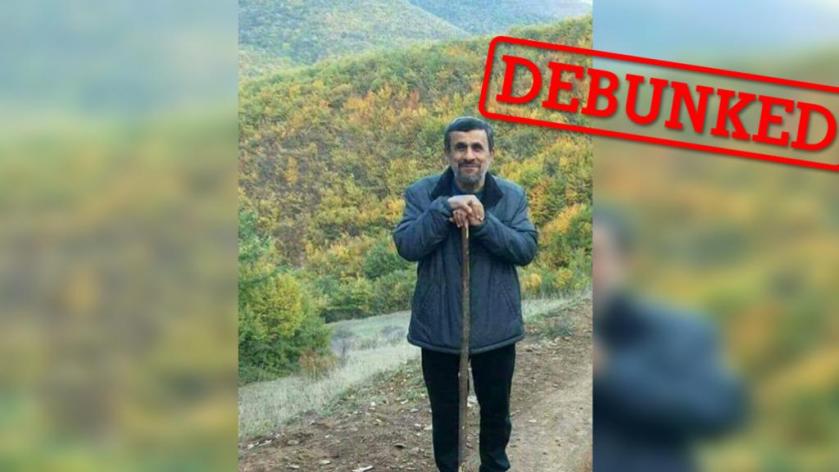
Since mid-August, a mysterious photo of former Iranian president Mahmoud Ahmadinejad leaning on a rustic walking stick has been widely shared on social media in Turkey – with captions saying he’s spending his retirement herding sheep in his village. It is not true: in fact Ahmadinejad is still in Tehran, still involved in politics, and facing multiple allegations of corruption.
The photograph shows Ahmadinejad in a forested area, in a padded jacket, with a stout stick in his hands. The photo has been published by a Twitter account with 2.2 million followers, an Instagram page with 1.6 million followers, and dozens of Facebook pages with hundreds of thousands of followers between them.
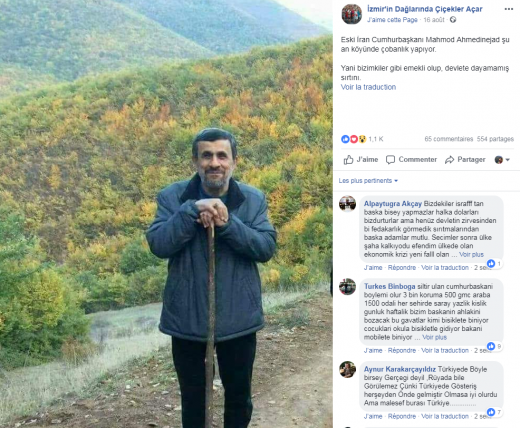
First off, Ahmadinejad does not live in a village; he lives in his house in the Narmak neighborhood in eastern Tehran. He is protected 24-7 by a team of government bodyguards.
Second, Ahmadinejad is back at his old job – a professor at the Iran University of Science and Technology in Tehran. He has a PhD from the university in civil engineering and transportation planning. A photograph posted on his official Twitter account Aug. 28 shows him at his desk with two laptops in front of him.
Furthermore, while Ahmadinejad has indeed left the presidency, he has not quit political life. He still sits on the Expediency Discernment Council, a high-level committee that advises Supreme leader Ali Khamenei.
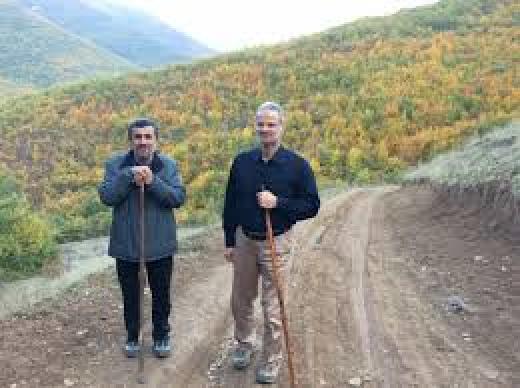
The photo shared by Turkish Web users actually dates back to 2017. It was taken during a weekend trip to Kandolus, a village in northern Iran that is a popular tourist destination. Other photos published of the visit show that Ahmadinejad was not alone: one shows him with a local friend, another with his bodyguard and friends around him.
Gülin Çavuş, editor at Teyit.org, says the fake story of Ahmadinejad’s post-presidential career touched a nerve in Turkey because of recent controversy over the pay and benefits of Turkish lawmakers.
In July, newly elected MP Kenan Sofuoglu of the ruling AKP, a former motorcycling world champion, faced criticism online after he showed up at Parliament in a Lamborghini sports car. In February 2017, Elif Doğan Türkmen of the opposition CHP stepped down from a leadership committee after racking up a 1.2 million lira communications bill in one year.
“This fake news about Ahmadinejad’s modest lifestyle has been massively shared on the various social media platforms. We’ve seen it of course on so-called ‘clickbait’ pages that publish viral stories to get traffic. But we’ve also seen it on left-wing and Islamist Facebook groups that are angry over financial inequality in Turkish society and critical of the luxury lifestyle of many Turkish political figures.”
“Many Turks complain that members of parliament and ministers take government salaries but do nothing for the people. The salaries of MPs, and their retirement benefits, have become a very sensitive issue. While the minimum wage is about 2,200 lira [285 €] a month, MPs earns about 20,000 [2,600 €]. People are angry over the photos and videos they see online of political figures’ expensive cars and houses – and that makes them receptive to this kind of rumour and fake news.”
It depends how you define a modest life. Ahmadinejad since the early days of his political career has presented his personal life as modest. For many years he refused to wear a suit, preferring to be seen in a white zipper jacket. He had an old Peugeot 504 as his personal automobile.
He campaigned against corruption while running for the presidency in 2005, and later had a personal website called Mardomyar, or “the People’s Friend.” But his second term was dogged by charges of corruption in his administration and some of his closest aides and deputies were convicted up to 15 years of prison for financial corruption. In July 2017, a prosecutor for the Supreme Audit Court said Ahmadinejad himself faced sentencing for 7 counts of misusing public money, including one case relating to misuse of 2 billion dollars during his second term.
The photo that Ahmadinejad tweeted of himself on Aug. 28 shows him with a Macbook Air, a laptop that costs 8 times the monthly salary of an Iranian worker.
Published first here on France24.
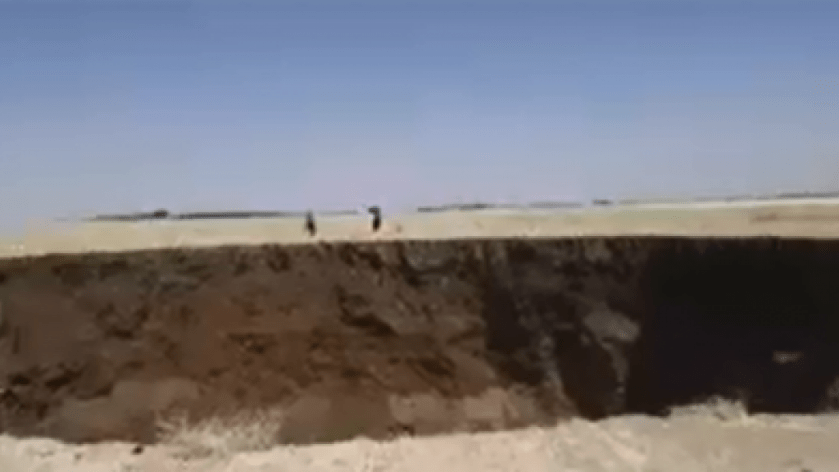
A giant sinkhole about 60 metres deep has made a surprise appearance in western Iran. The sinkhole opened up on August 19 near the small village of Kerdabad, in the Kabudrahang county of the western province of Hamadan. It has terrified both locals and experts, who say this phenomenon shows that groundwater tables have been badly damaged.
The images of this giant hole in the earth are even more chilling due to its location: the sinkhole is only one kilometre from a village with more than 2,000 residents, and only a few more kilometres from a solar power station, a thermal power plant and a major national highway.
This video of a sinkhole near the village of Kerdabad in the Iranian province of Hamadan was circulating among Iranian users via the messaging app Telegram in August 2018.
A shepherd who witnessed the pit’s creation described it to Iran’s state media:
“It was about 3 pm and I was just 20 metres away from where the pit would open up. Suddenly I heard a strange, deep noise and saw lots of dirt flying up in the air. One second the hole wasn’t there, and the next second it was. People in the village are now afraid – what if it happens again, but this time in the village? We ask the authorities to find a solution for us.”
This is not the first time this phenomenon has occurred in the region – it is actually the 13th giant sinkhole to have appeared in Kabudrahang county in two decades. So far, none of them have opened up inside villages or cities, but some have come close.
According to Iran’s Tasnim news agency there are 90 sinkholes in all of the country, including 25 in Hamadan province.
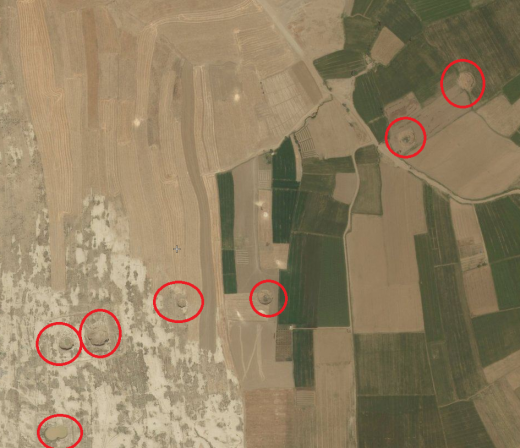 This image from Google Maps downloaded Aug. 27, 2018 shows sinkholes that have appeared in Hamadan province. The circles were added by France 24.
Amir Shemshaki is the director general of the bureau of geohazards, engineering and environmental geology at the Geology Survey and Mineral Exploration of Iran, which is a national agency.
“These sinkholes are caused by large domes under the earth that collapse in on themselves. They usually take place in sedimentary layers, mostly in calcium or lime.
There are many natural and human-made reasons that can lead to these collapses. The natural reasons include large amounts of water washing through them, or simply that they become too heavy over time. Human-made reasons include overconsumption of ground water – if the dome’s structure is too dry, it weakens – as well as the presence of wastewater with high levels of PH, which can cause calcium and lime to dissolve.
In Kabudrahang county, there are several factors combined: there’s an overconsumption of groundwater, it has a high PH, and the ground formation is based on lime, which dissolves easily.
To prevent the formation of sinkholes, the agriculture in this region must be adapted. Water consumption must be reduced via more effective irrigation practices.”
According to the Hamadan province water company, there are at least 1,000 illegal water walls serving 120,000 hectares or agriculture in Kabudrahang county, and this has reduced groundwater levels by 40 meters in the past 20 years.
According to Nasser Karami, an Iranian physical climatologist based in London, “In less than 50 years, Iran has used up 70 percent of its groundwater supply, which took a million years to build up.”
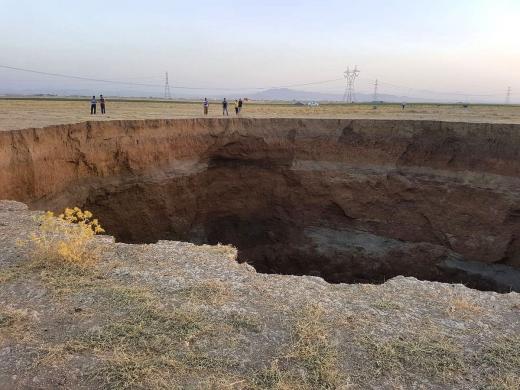
Shemshaki continues:
“Sinkholes pose a huge risk to the people living in [Kabudrahang county]. So we must closely monitor urban development and carry out careful surveys so that any plans for construction in risk-prone areas can either be stopped or relocated.”
Iran has been hit by drought for five decades running. According to the Iran Meteorological Organisation, 90 percent of its territory is currently experiencing drought, although the levels differ from region to region.
 Ershad Alijani